Yesterday, I got sucked into a FB comment tread, posted by my friend Craig Carrick, about the recent, irrelevant VMA’s. (Craig–a major music fan, a house concert host, a father–hit the nail on the head about that topic.)
On the comment thread, someone posited, “Where is this generation’s Neil Young?”
I rolled my eyes, I sighed, and then I felt sad.
I also realized something: We are living in a major music inequality gap.
* * * The Music Inequality Gap * * *
There is a major divide in how people consume music today. It’s as wide as the income, inequality gap in our country. I call it, “The Music Inequality Gap.”
The gap’s two sides are these:
Side A: those who discover and consume music through 10-20, even 50 sources, usually online, including a streaming platform, sometimes Youtube, and elsewhere…
Side B: those who want to still consume music through the old ways (commercial radio and TV). They might even buy a few CDs a year. Yes, this side tends to be older.
Side B is getting left behind.
* * * Side B’s Despair* * *
Yet Side B actually wants to consume their music on radio and TV. Then, when they feel a great despair that they are only getting shit on those platforms, they complain.
Side A says, “No shit, Sherlock!”
I don’t need to tell those on side A that this generation’s Neil Young can be found in so many ways, that the question is irrelevant. (They also know the VMAs are irrelevant. MTV doesn’t show music videos. That’s Youtube.)
* * * The Problem * * *
The problem is no longer that TV and commercial radio are terrible places for art*; the problem is is that Side B refuses to change how they consume music.
Yet Side B still thinks their complaints are relevant.
It’s not. That ship sailed.**
If you want to find new music that inspires you, you can do this with a simple click of a streaming platform, or an artist’s Bandcamp, or a number of ways. You can share that music with your friends with a simple click too.
If you don’t want to change with the times, you’ve already been left behind.
* * * Why This Matters * * *
This matters to indie bands and musicians in a similar fashion as the shop local debate matters to main street.
If you don’t want to adapt to the new ways of discovering music, then new music, like myself, have an even lower chance of breaking out regionally. Radio’s impact is lessening each quarter, and major labels aren’t investing in many new artists.
In a DIY culture, we need Side B to join Side A. Right now, Side A isn’t enough people to help enough indie artists make a little money, and that money is used to invest in the things the majors would have funded.
The indie artist is lucky to have crowdsourcing options like Kickstarter or Pledgemusic, but that might only be a one-time shot. And it doesn’t help your music get to new ears.
So side B, it’s time: Abandon radio as your main source. Abandon MTV. Keep your vinyl if you must. But Join us on side A. The water’s just fine.
Footnote:
*Don’t get me wrong. TV and radio are terrible places for art, but it has been for a long time, and it’s a dying media. It’s not making profits like the past and it’s a sinking ship.
* * Leftsetz has diagnosed radio’s sinking ship already.

Coldplay’s chorus in “The Scientist” has a brilliant lyric:
“Nobody said it was easy
No one ever said it would be this hard
Oh, take me back to the start”
Sure, this is a sad love song, but that theme captures so much more than love.
We all face roadblocks during our journey, and it’s often more difficult than we had imagined. But we won’t get anywhere new if we chase our tails.
Rethink the past, but always do so to inform the future. Like a scientist.
The best satirical essays are the ones that hit the truth so well, you almost forget they are fictional.
Like yesterday’s Onion’s “Let Me Explain Why Miley Cyrus’ VMA Performance Was Our Top Story This Morning.”
Chemical weapons affected 3600 Syrian civilians, yet we are lost in a whirlwind of tweets and Facebook posts about an unoriginal pop star doing a ridiculous performance on an equally irrelevant award show.
(If there is a question leading to a worthy news story hiding in the VMAs, it’s this: how many arrogant, middle-aged males in the music business were involved in creating that impressionable 20-year-old woman’s performance?
No one seems to be asking that question, but I digress…)
* * * * * *
Tuesday, I continued to be dismayed over the unequal attention of world news vs. entertainment news; so I reread Tim Skubick’s essay from early August titled, “Journalists are here to inform, not contribute to society’s well-being.”
I was looking for some clarity; but I went looking in the wrong place.
Skubick describes a journalist as “being an umpire. You call them as you see them, try really hard to get it right and you don’t walk on the field hoping to win a popularity contest.”
He makes some great points in his essay, even if I’m still having trouble deciphering his main theme.
But this week complicates it more: Journalism has a responsibility to report what is important, not simply sensational. Yet in a world-wide-web measured by clicks, sensational wins.
So isn’t the popularity contest already winning?
Another notable quote Skubick says in his essay is: “The harsh reality is your local blogger, and God bless them for being involved, is not the same as a seasoned reporter. But the consumer treats them all the same and the sins of one is superimposed on the other.”
The lines between “seasoned reporters” and “local bloggers” will continue to blur as publications lose credibility.
Plus, Tim should be my local blogger. He’s from Michigan, reports from Lansing. Sure, he’s a seasoned reporter, but I’m reading his essay online. Maybe he’s my local blogger, whether he wants to be called that or not.
I’ll admit, I’m feeling disenchanted today. I don’t know how to end this rant, except with an observation: I forgot which essay was satirical; the Onion’s or Tim Skubick’s.
Did you read this NPR essay about “the sight of music”?
The writer, Alva Noe, discusses how “music is action,” that listening to music is a physical performance we view as much as hear.
It’s a really great read, especially for the avid music fan or concert attender.
I’d like to add one more idea: Music is action, and it becomes so much more when you also create it. Once you start playing an instrument, you never hear music the same way again.
Some people may feel this ruins “the magic” of music; but I argue the opposite. Ignorance isn’t bliss. Playing an instrument opens the mind to the complexity of musical sounds, and also musical feelings.
The essay discusses what it’s like to “see a performance” from the audience side; but flip that around: It’s a beautiful thing to see (and hear) from the musician’s side, too.
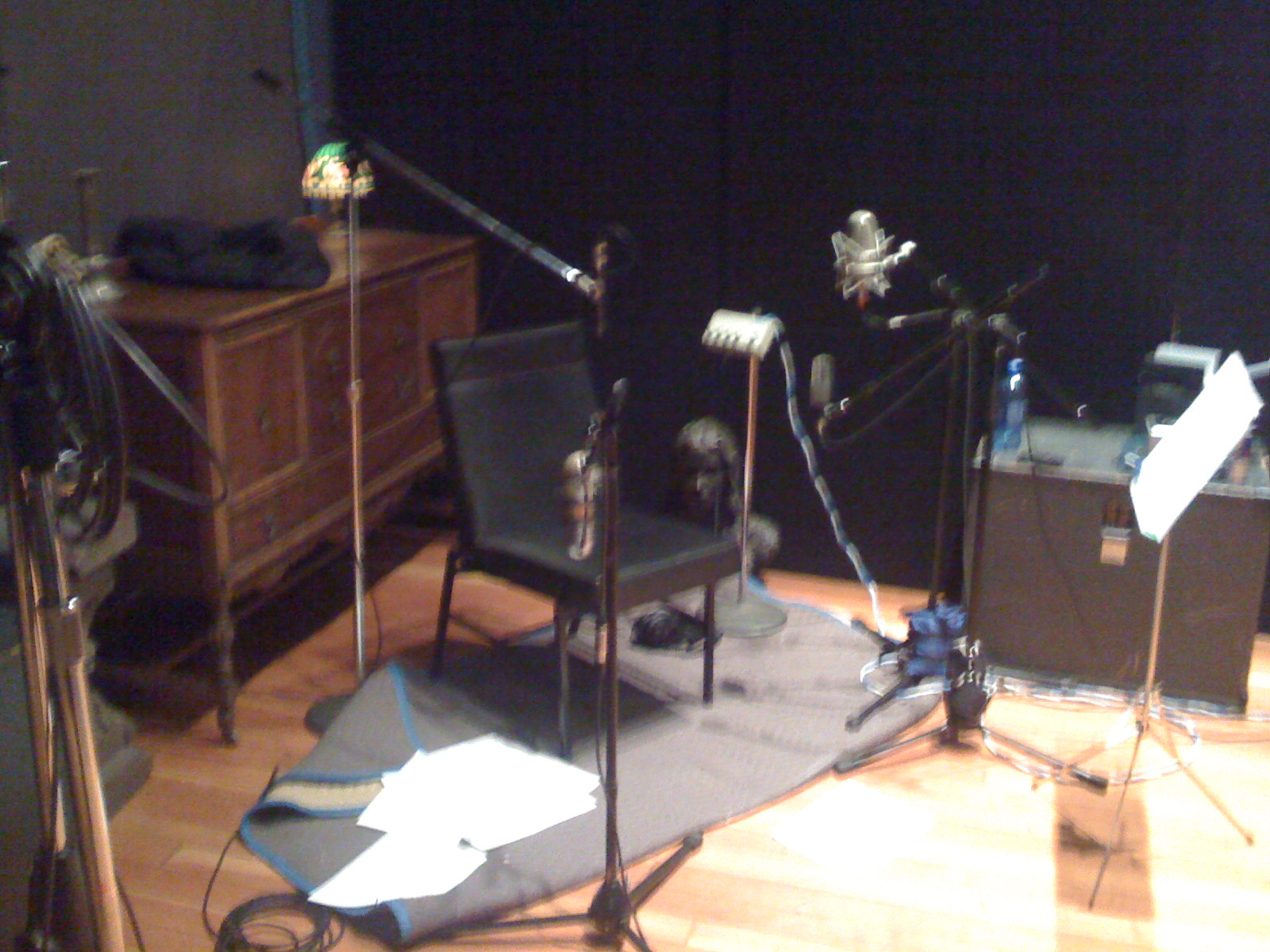
One mic technique Dan Achen used was adding a third microphone by the guitarist's ear, to capture the way the guitar sounds to the guitarist and blend it into the mix. (We used this technique on Burning the Boats.)
Humans, Cell Phones & Cars; Why Are We So Stupid?
I’ve been trying to stop myself from using my cell phone while driving. It’s proving to be more difficult than it should be.
Recently, while waiting at a red light, I’ve started counting how many people in cars around me are looking at cell phones. Once, at a busy intersection in Ann Arbor, I counted all four cars around me with drivers with their heads down, staring at phones.
I know I’m part of the problem; I need to be part of the solution.
Which leads me ask my fellow humans, why are we so stupid?