Who Cares about Country Music’s Identify Crisis on Radio?
Complaining about the identity of a music genre based on current radio formats seems silly now a days.
Let’s consider the current country music crisis: “How country music went crazy: A comprehensive timeline of the genre’s identity crisis” bit.ly/17c9klo
I know genres change and people get upset, but it seems like the only people who care about the country crisis are those at the top of the food chain. While radio is still the way most new music is heard, how most new country singles are digested, which equals sales, it’s impact lessens each year, heck each quarter.
The kicker: If you go to Youtube and search “Johnny Cash cover,” 925,000 results pop up. Search George Jones cover: 473,000 results.
We live in a time where people are discovering more and more music every day, without the radio. Genres are going to be blending, but music fans will study the history of originators through Youtube and websites…
Country is doing just fine, unless all you listen to is top-40 radio formats. And if that’s the case, than one could argue an identity crisis for any type of music.

The Creation Is More Important Than the Explanation
I once tried to explain to a piano player why I bring two guitars to gigs, so I could play certain songs, like “One Way Road” on a retuned guitar.
(Guitar players will understand this: the second guitar is tuned a whole-step down, so a C chord is a Bb. It’s so I can sing songs in my vocal range, but still use certain open chords with intricate riffs.)
Her response was, “The guitar player in my band changes the key to songs for me all the time, and he only brings one guitar. Can’t you just…”
“No, I understand why that works for many songs, especially blues–I do that too–” I replied, “but let me show you why that doesn’t work for this riff.”
I showed her the opening riff to “One Way Road.”
“See how my fingers need the open strings for the dissonance? How the pull-offs are essential to the tone?”
She looked skeptical.
“See how I need the chord shape to this riff, but I need sing it in Bb for my vocal range?” I pleaded.
“I don’t know…” She said. “My guitar player changes keys…”
So I gave up explaining. Her frame of reference was the piano, where changing keys can happen more easily than certain guitar parts; where a note isn’t bent, slide, pulled-off or hammered on.
Plus, she had made up her mind that I was wrong.
More importantly, I realized that it didn’t matter if I convinced her or not. I would always play “One Way Road” on my whole-step down guitar. She wasn’t convincing me to only bring one guitar to gigs.
When you are the creator, you don’t need to explain yourself. The creation is more important than the explanation.
An early version of the song, with an example of the opening riff:
Injuries are bound to happen when work requires physical labor.
And yes, being a traveling musician is physical labor! I’m often carrying speakers, guitars, and boxes of gear, sometimes for blocks when gigging in cities like NYC or Chicago, five nights a week.
During these last two years, I’ve fallen through my apartment stairs, sprained my ankle, and dropped a speaker on my foot.
But the most prevalent and annoying injuries have been a tiny, simply accident: pinching my fingers with mic and speaker stands! Blood blisters are not a guitar player’s friend.
We worry about the catastrophic, but the little accidents most often derail a gig, yet they are usual preventable.
Musicians, be careful out there! And wear gloves when packing gear!
(Note, I’m fine and injury free, since the spring.)
The Detroit music scene. The Brooklyn music scene. The Lansing music scene. The Chicago Roscoe Village music scene. The Berkley, DIY, underground punk scene…
In the music business, you hear the word “scene” a lot. And we often wonder how we can help or create a thriving music scene in our own areas.
But maybe one way to help a music scene is to stop calling it a scene.
Isolating music into a “scene” ignores its larger role. Music happens in bars, open mics, coffeehouses, museums, block parties, house shows, basement parties, porch jams, classrooms, charity events, Internet videos. The music scene is a part of a larger scene.
That scene is called a your community.
Musicians and artists need to be a part of their community to thrive. If we focus on a “scene,” we might be missing out what else is going on around us.
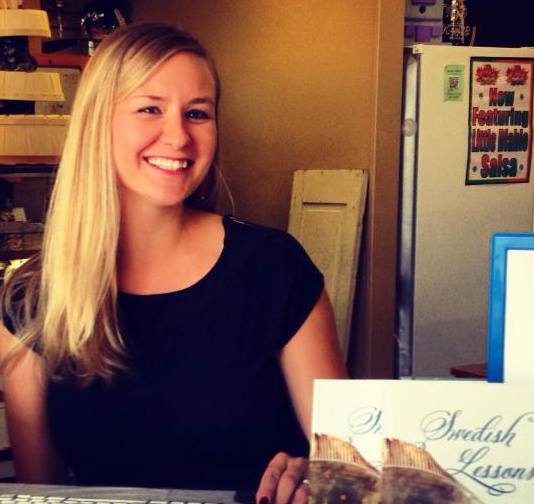
Natalie’s interview about her new book, Swedish Lessons, for Stateside on Michigan Radio will be on today at 3 PM and 10 PM!
Ann/Detroit: 91.7 FM, West Michigan: 104.1 FM, or Flint 91.1.
Or Stream at 3 PM and 10 PM at michiganradio.org (click Listen Live at the top)