Set List: Aug 27, 2015 – Fiddler’s Hearth
Thursday, Aug 27, 2015 – Fiddler’s Hearth
South Bend, IN
-
 Don’t Mess Around with Jim (Jim Croce)
 - Damn Fine Day
- Only the Rain Knows Why
-
Drift Away (Dobie Gray)
-
Landslide (Fleetwood Mac)
-
Ohio (Neil Young)
Downloadable studio releases linked.
Big thanks to Dena Dena Dena for having me at the show!

Which voice speaks louder than the other?
Which voice speaks louder than the other:
The creative voice, that says, “Let’s explore this idea!” or the critic, that says, “This idea isn’t any good”?
More importantly, which one is harder to harness? Is it more difficult to come up with unique ideas or squelching the voice that interferes with the creative process?
Either way, the second voice must be ignored to allow for the first voice to speak.
* * * * * * * *
I finished my first poetry commission last week, and it felt great to be not only writing, but be inspired to write from someone’s request.
And while it’s also great to be paid for one’s writing, the money serves as another motivator, saying, “This work must get done!”
We don’t always need an advance sale to be that motivator. Maybe there is an upcoming art show, a concert, a recording session, or a lecture you can schedule that will require work to get done.
Douglas Adams joked, “I love deadlines. I love the whooshing noise they make as they go by.”
Deadlines make another sound, being a third voice, that says, “Get to work!”
* * * * * * * *
Want to commission the next poem? Be the muse, and a patron:
http://mikevial.bandcamp.com/merch/be-the-muse-commission-a-poem
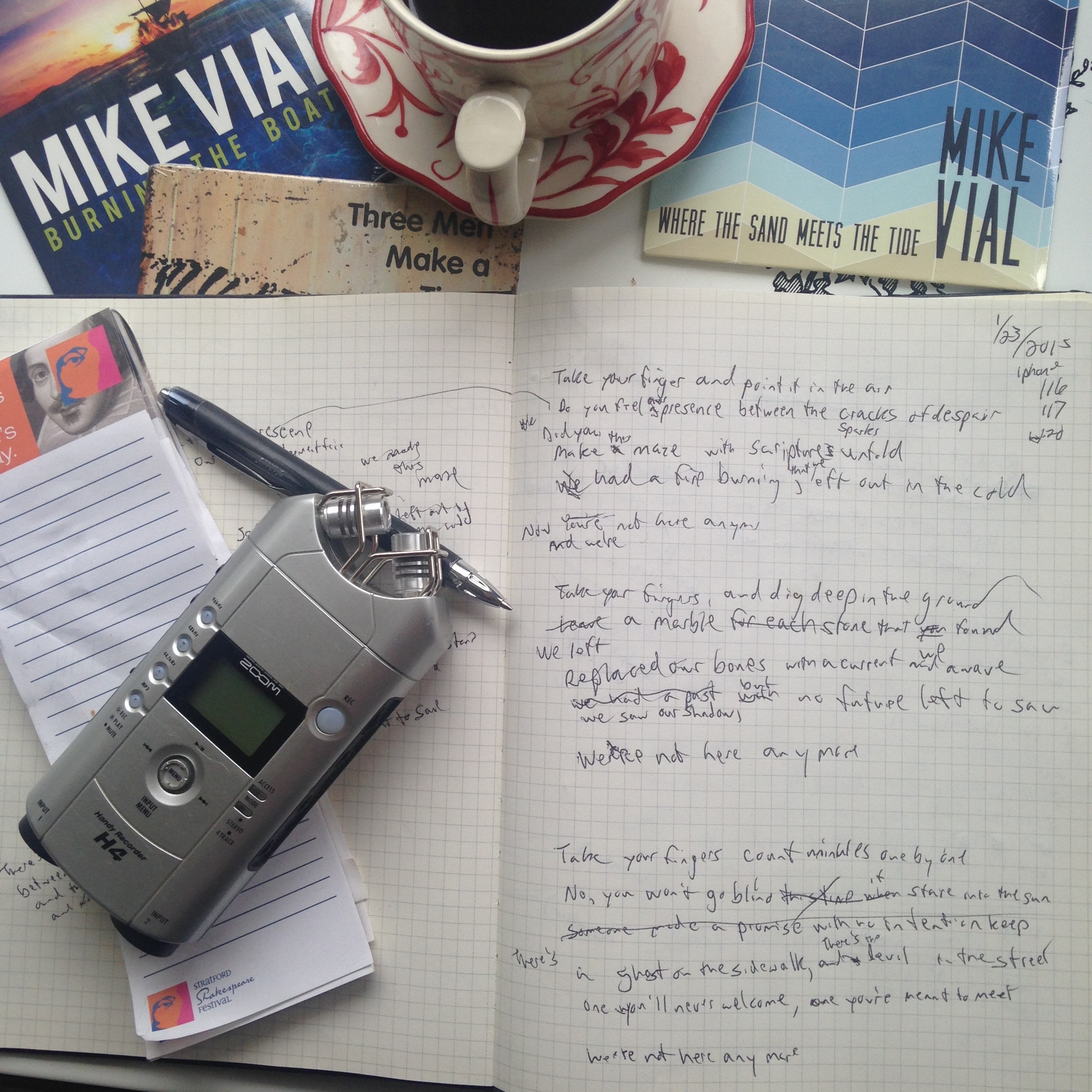
[While watching Ginny in the mornings and afternoons, I’m avoiding the TV and listening to music instead. Today, Ginny got to hear Santana’s Abraxas for the first time!]
How many pop artists today are quoting Hesse on the back of their MP3s?
My dad reminisced, “We couldn’t afford to buy many records after your grandmother died and your grandfather was working shifts at General Electric [in Detroit].” The best albums were the ones my dad would warn, “Don’t get caught taking that one to school!”
- 0:10: Piano’s panned right, organ’s panned left, which is really great at 0:48; percussion’s panned, too.
- 0:18: Enter vibroslap!
- 2:33-3:42: Eat your heart out Protools producers with your click tracks, no way this one was recorded on a grid with the rhythm and time signature changes!
- 3:00: The guitar lick is an example how tone comes more from the hands than the equipment: the volume swell/feedback into a bend/trill, into soft notes!
- 4:46: Which instrument is going to end the song? The guitar, no the piano, wait the bass slide; ah the percussion!
Accepting the Facts: We only make time for great
Last night, I asked my friends on Facebook:
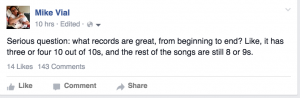
It only took about two hours for 15% of my Facebook circle to chime in and deliver, offering 200+ recommendations ranging from Jeff Buckley’s Grace to Fleetwood Mac’s Rumors.
Sure, tastes vary, but even metal heads offered records that made me pause and say, “Yep. I get it. That’s a 10 for that genre.”
* * * * * *
What does this mean for songwriters?
Nate Dorough from Fusion Show‘s has emphasized this to me, and Lefsetz has stated this many times in his newsletter and keynotes:
“Because of the Internet and streaming services, we don’t have time for good. We only have time for great.”
Artists are caught up discussing payouts from streaming services; maybe it’s more important to recognize the overwhelming reality that good isn’t good enough, now.
Seriously, are you going to listen to an OK record when you have all the great ones at your fingertips?
Since scarcity has disappeared, the consumer’s expectations have changed.
One thing hasn’t changed: New songwriters need to allow themselves time to work towards great, which takes a lot of practice and hard work to get there. Yet here’s some irony: the Internet has made it so easy to publish. Finished that demo of a song? You can share it with a few keystrokes!
But then crickets.
A great guitar teacher said her students ask her, “How long will it take me to learn this song?” She always says, “Longer than you expect.”
As a songwriter, I’m trying not to feel too overwhelmed by the challenge at hand: aim for, and only release great. It takes a lot of writing of OK and good songs before a great one is found.
Before we climb a mountain, we must see it; approach it; and accept the challenge.
Music Biz is like the A/C Biz (Don’t complain; decline)
Booking gigs can be a frustrating experience.
One post has been circling the musical corners of the Internet for a few years: “Why Music Venues Are Totally Lost: An Open Letter from a Professional Musician” – read here
Today, a post from Grassyroots about the same theme caught my attention: “Dear Person Asking Me to Play Your Gig” – read here
These posts make a lot of sense. Musicians have understandable pet-peeves.
However, here’s something these posts aren’t saying: look for red flags, stick to your standards, and decline the gig.
* * * Music Business; the A/C Business * * *
When approached by a potential client, you need to ask direct questions and look for red flags, and you should decline the gig when seeing warning signs, hints of unprofessionalism, or things that aren’t a good fit for where you are in your career.
My brother-in-law Corey helps manage a successful A/C business. We were sharing stories about the challenges of running one’s own business, and discovered how the music business is very similar when it comes to talking to clients.
A/C work can be stressful. Someone’s air-conditioner is broken. It’s a 100 degree day in Texas. That person wants their cooler fixed, now!
But there is a waiting list. There are challenges to diagnosing problems. There are folks who don’t want to pay for quality repairs. And some are looking for the lowest price point, yet expect the highest results.
Corey told me, “I listen for red flags when I’m talking to potential clients on the phone, and I might say something that will dissuade them from hiring us, before I even have to decline the work.
I have to protect my repair workers’ time, and a demanding client who wants to pay less to nothing is going to hurt the business.”
* * * Questions to Ask * * *
As a musician, we need to do the same thing. Ask questions:
- How much does the gig pay?
- What does the venue expect?
- What do you expect from the venue?
- What promotion will the venue offer?
- How much times goes into this gig?
- How will this gig affect other gigs in the calendar?
If you are a professional, you don’t need to spend your time complaining about unprofessional businesses; you decline the work. You move on. You save your time and best work for your respectful clients.
PS: If you aren’t getting enough work, and feel the urge to take on unprofessional clients to get by, you need to brainstorm changes, ASAP. It happens for all of us, but as Seth Godin says, “don’t race to the bottom.”