If you don’t want to put your name on it, don’t do it
As the Internet continues to evolve–from blogs to click-bait articles, to message boards to social media–one thing I find odd is how anonymous trolling seems more powerful than ever. The Internet gave us a chance to put our name on our work and release it. It also gave us an opportunity to fail.
So many people spend their time commenting on the message boards of news articles, which must be the biggest waste of time ever created by the Internet. And few every put their name on their opinions.
This is what I love about Ari Herstand who writes about music industry topics. Read his Adele piece, and skim the commenters, a large percentage attacking the person rather than the point.
I don’t agree with his tone in the Adele piece, but understand his point; and Ari Herstand puts his name on his work! He faces the criticism, publicly!
(What’s one of the most scary responsibilities a person can tackle? Having a baby! And guess what, the baby usually gets our last name!)
It’s more courageous to release a blog and get zero readers, a new song that gets zero sales, than to post some anonymous comment on a message board, getting the other anonymous comments all riled up.
Put your name on your work. If you don’t want to put your name on it, don’t waste your time doing it.

My Spotify 2015 stats:
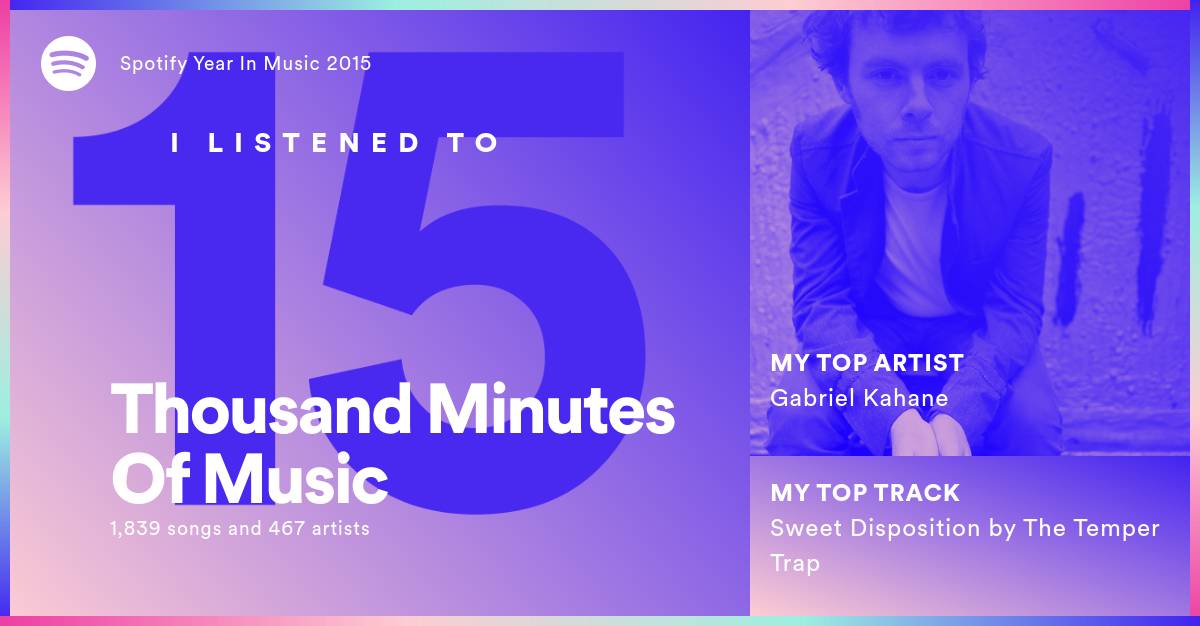
I listened to 15,000 minutes of music. (That’s 249 hours, or 10 days worth of music consumption.)
Most listened to artist:
Gabriel Kahane: 409 streams
Brooks Williams: 210 streams
James Taylor: 109 streams <—Factoid: I accidentally, left Spotify playing JT on mute one day.
Lake Street Dive: 150 streams
Death Cab for Cutie: 128 streams
Albums:
Gabriel Kahane’s The Ambassador: 359 streams
Brooks Williams: Brooks’ Guitar 209
Lake Street Dive, Bad Self Portraits: 148 streams
Chris Thile’s Bach Sonatas – 89 streams
Death Cab for Cutie’s Transantlanticism: 67 streams
Top Songs:
“Sweet Disposition”: 59 streams (I learned it for a wedding in July!)
“Eye of the Tiger”: 54 streams (LOL! All from guitar lessons and the rock band class I taught!)
The next three top songs are from Gabriel Kahane’s The Ambassador:
“Black Garden”: 44 streams
“Veda”: 44 streams
“Empire Liquor Mart”: 43 streams
Other Stats:
I listened to 467 artists.
1839 different songs (31 more than last year).
467 artists actually seems low to me, since I use Spotify for teaching guitar lessons, and I had 30+ students at Expressions.
Question, I’m wondering:
How many total streams did I listen to in 2015 total? My estimation is: 4000-6000 streams, if a song length ranges from 2:50-4 minutes long. (However, Kahane’s Empire is 9 minutes long!)
So how much did Spotify pay the artists I listened to this year?
I pay $120 a year. 70% goes to rights holders ($84).
From my calculations, rights holders should be getting at least $0.01-0.014 a stream from me, but I’ve never seen a royalty that high on my end as an artist.
Spotify claims the average pay out is $0.006-0.0084 per stream. If that’s the case, I only paid out $40-50 to rights holders this year. Something doesn’t seem right here.
Did I do the math incorrectly?
Has streaming devalued music?
It takes 1500 streams to equal an album sale, 150 to equal a single sale. If I’m an above average streaming consumer, and my top artist is only making $2-4 from me, that doesn’t seem right.
Downloading 1839 songs would have cost almost $2K. I had access to all of this music for $120 this year. However, if we listen to these songs on Youtube, they’d have made less revenue. If we traded harddrives, they’d have made zero revenue.
New Car = More Streaming
I expected Frances Luke Accord to be in my top five streamed artists, but I listened to them via CD for 1/2 of the year. My 2001 Ford Escape died this summer. It didn’t even have an aux input! The same five CDs were in my car: Frances Luke Accord, City and Colour, Nataly Dawn, Chris Cornell’s first solo record, and a voice lesson CD.
Now that I have a newer car that connects my iPhone via Bluetooth to the radio, my streaming intake will increase.
The power of the simple, immediately applicable idea
I watched Derek Siver’s WDS talk yesterday about the things he learned starting CDBaby.
It’s superb, full of many big and small lessons for the entrepreneur.
My favorite part? When he says, “I change the color on the PowerPoint when I change topics.” Wait, what? Why didn’t I think of that as a teacher!? Boom, now a technique I can employ!
Later in the day, I watched a lecture by Martin Atkins where he describes a PR ideas for music, including a brochure he did SXSW visit. He thought the “win $4000 of music gear” was going to be thing that got everyone’s attention on the brochure.
Nope, the favorite part of attendees was the $1 off the local pizzeria.
Don’t forget, the simple and immediate ideas can make a powerful impact!
While one aims for clarity, a comedian doesn’t explain the joke to the audience, even though she knows a portion of them might not get it.
She moves on to the next joke, while the confused scratch their heads.
I love this aspect of comedy. I think songwriters and artists can borrow from that expectation of the audience, that they must do a little work, come to the venue with prior knowledge.
When releasing music that’s challenging, we need to be prepared for part of the audience not to get it. When I was 15, I didn’t get a lot of the themes of the 90s era music, especially the Babes in Toyland record. Now that I’m older, more well-read, and have watch the Riot Grrrl documentary and the Punk Singer, I’m ready to revisit those songs, with ready ears.
Reach out to the listeners who are ready. For the one’s who aren’t, let them scratch their head. That’s often their first step in a wonderful journey of studying up on something new.
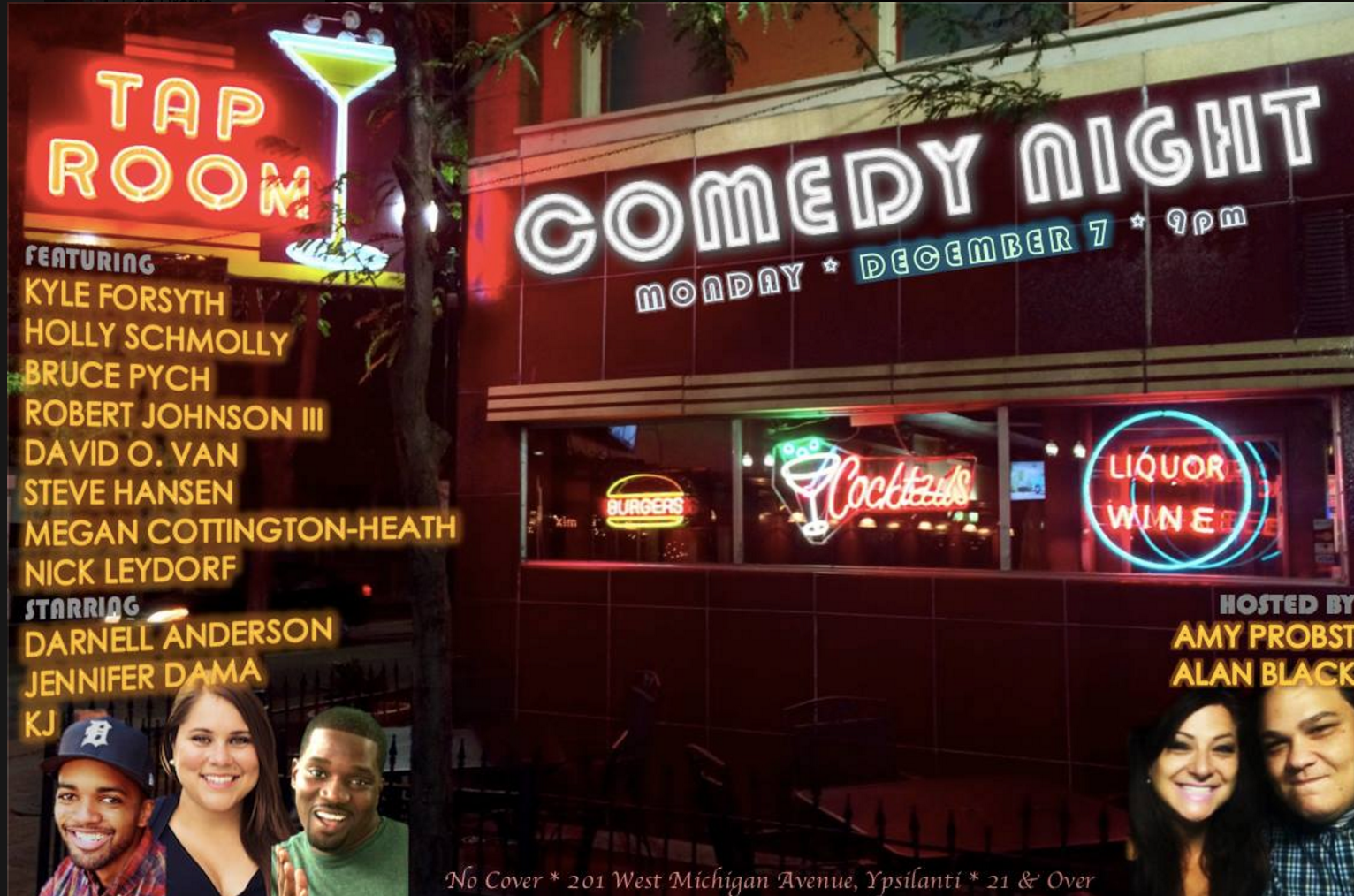
* * * * Tap Room’s Comedy Night – Mondays * * *
My friend Alan Black is co-hosting a Monday comedy series in Ypsilanti, MI, and it’s going really well!
No cover. Mix of new and experienced comedians for a great show. Ypsilanti’s Alan Black and Amy Probst host.
More info at their Facebook page.
Cobain, Layne, and now Weiland.
Died at age 27, 34, 48.
When we are teenage musicians, we study our musical heroes underneath their posters tacked to our bedroom wall.
When we are adults, we might not have those posters on our walls, but we continue to see them rock the stage; usually the audience demands to hear the old hits, but hopefully the artists make art that challenges the culture.
Last year, when Weiland had a rough gig in Texas, it was easy to see his decline, easy to write a headline, even a joke. When substance abuse of the famous leads to tragedy, it sometimes feels so distant to our own lives, but it’s not.
Addictions are rampant in our towns and circles, in our communities. And it’s passed over the counter, or written on a script. Amy Winehouse’s father often said it was the alcohol abuse that killed her. Prescription medication abuse is a growing epidemic.
Yes, this requires a discussion of personal responsibility; but it’s also a discussion of community responsibility. Today we are going to discuss a loss of a musical icon. Tomorrow, we need to continue the discussion of substance abuse and how to help those suffering, and discuss how to help the friends and families trying to help the addicted, too.
A crime or a health problem? Maybe both, but in the Odyssey, we are warned of the universal dangers in a chapter called the lotus eaters; it’s the shipmates that return, following the orders of their captain, pull their lost companions out, and get them back on course.
Some musicians can’t pull themselves out; the gigging road can often seem like returning to the lotus eater’s island.
Cobain, Layne, and now Weiland.