Your Spotify data proves recorded music’s devalued.
Artists are often told by pundits or industry folks, “Your audience isn’t big enough. No one is listening to your music. That’s why you aren’t getting paid through streaming!”
I tend to agree, to a point. But what about artists that do have audiences? What about our TOP streamed artists from our own listening behavior?
Spotify’s sharing that with Year In Music. Look your’s up!
I queried my friends for their data about how many minutes of music they streamed, and how many streams their top artists accumulated from their accounts.
Six of my friends wrote back. All of them are major music consumers. Five streamed more than me, four almost doubled my 14,000 minutes. (I thought I was a major music consumer, but maybe I’m average!)
But how long will it take those streams to equal one sale? Here’s the streaming for folks top artist:
- Dan (from my favorite jam group Liquid Monk) streamed Flying Lotus 720 times.
- Brian streamed Wilco 600 times this year.
- Jake streamed Elliot Smith 600+ times
- I spent 409 streams with Gabriel Kahane
- Nate spent 276 streams on Catfish and the Bottlemen
- Josh Woodward (a songwriting hero!) streamed Death Cab 232 times.
- James said his top artists were between 200-300.
None of that equals a sale yet, folks. (1500 streams is one album sale; 150 streams is one single sale.) And that’s our top artist!
How long would it take for just our top artist to get one sale from us? If we still stream their music at this rate, three years? Five years? (Plus, if you are using the ad-tier, which might pay out $0.002 or less, forget it!)
What about our fifth most streamed artist? How long would it take them to earn a sale?
Plus, next year, do you see your top five artist staying the same? It could take five to ten years to stream our top artists enough to earn one sale.
Ten years? Really?
I’m not saying this is right or wrong, but the debate is over: recorded music has been devalued by this system.
1000 true fans on a streaming platform is not the same as 1000 true fans buying a CD, or vinyl, if you are lucky to have an audience that buys those beautiful, black records.
I’m not suggesting we should take our music off of streaming sites, nor am I suggesting selling CDs is an answer when computers don’t come with CD drives. I do understand why major artist are pulling some punches windowing releases, but we don’t make royalties off piracy, off folks trading hard drives, off folks ripping CDs off of libraries.
So musicians and songwriters, we have to adapt to survive. I don’t know what that looks like, but everyone’s road is going be unique.
* * *
PS: Fewer than 10% of ad-tier consumers on Spotify streamed a full album. Playlists and singles were their choice. – via Hypebot

The perfect Spotify consumer; how much an artist makes
At $10 a month, Spotify costs $120 a year (+tax) for a subscription. 70% of that goes to rights holders. ($84)
As artists and consumers, we often ask, how much does Spotify pay per stream? Spotify admits it doesn’t actually pay per stream, but that’s the only way for us on the outside to really get an estimation.
If you looked at your “Year in Spotify” data as a consumer, here’s something to consider: How much are artists making from your streams? It takes 150 streams to equal one single sale; 1500 to equal an album.
Spotify says the average pay out is $0.006-0.008 per stream. If $84 dollars goes to rights holders, that means 875-1167 streams per month is the sweet spot for an artist to earn the average rate.
If you stream more than that a month, artists will earn less. Spotify isn’t going to pay more than 70% to rights holders. So if you stream 1750 tracks a month, artists might earn about $0.004 per stream.
However, what if consumer only consumes 400-500 streams that month? Does an artist make more? I never see a payout more than $0.005. Shouldn’t an artist be earning $0.01 or more if I don’t stream a lot? I’ve never seen a payment that high as an artist!
What if I only play ONE artist all year! Does that artist earn $84?
Something does seem right to me.
* * * *
Either way, niche artists don’t make much from streaming. Time is against an artist.
I asked my friends how many streams their top artists got from them. No one was even close to half of 1500 streams for one artist in a year. Most were in the 200 streams range. Plus, if they are using an AD-tier, it might take triple the streams to equal a sale.
If you don’t want to put your name on it, don’t do it
As the Internet continues to evolve–from blogs to click-bait articles, to message boards to social media–one thing I find odd is how anonymous trolling seems more powerful than ever. The Internet gave us a chance to put our name on our work and release it. It also gave us an opportunity to fail.
So many people spend their time commenting on the message boards of news articles, which must be the biggest waste of time ever created by the Internet. And few every put their name on their opinions.
This is what I love about Ari Herstand who writes about music industry topics. Read his Adele piece, and skim the commenters, a large percentage attacking the person rather than the point.
I don’t agree with his tone in the Adele piece, but understand his point; and Ari Herstand puts his name on his work! He faces the criticism, publicly!
(What’s one of the most scary responsibilities a person can tackle? Having a baby! And guess what, the baby usually gets our last name!)
It’s more courageous to release a blog and get zero readers, a new song that gets zero sales, than to post some anonymous comment on a message board, getting the other anonymous comments all riled up.
Put your name on your work. If you don’t want to put your name on it, don’t waste your time doing it.
My Spotify 2015 stats:
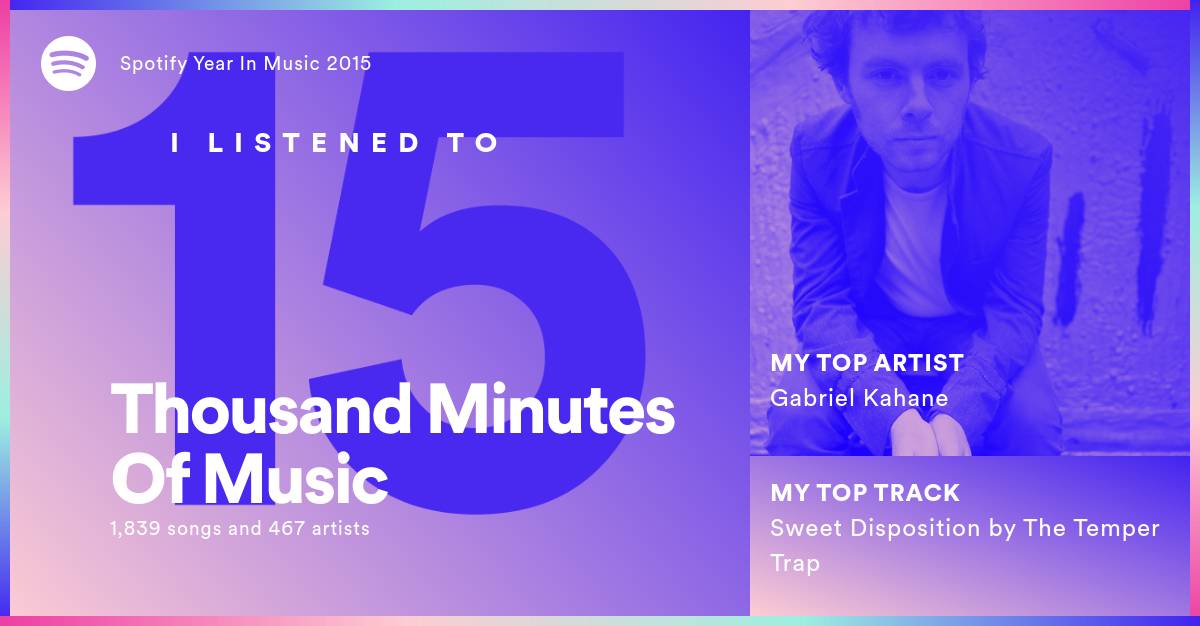
I listened to 15,000 minutes of music. (That’s 249 hours, or 10 days worth of music consumption.)
Most listened to artist:
Gabriel Kahane: 409 streams
Brooks Williams: 210 streams
James Taylor: 109 streams <—Factoid: I accidentally, left Spotify playing JT on mute one day.
Lake Street Dive: 150 streams
Death Cab for Cutie: 128 streams
Albums:
Gabriel Kahane’s The Ambassador: 359 streams
Brooks Williams: Brooks’ Guitar 209
Lake Street Dive, Bad Self Portraits: 148 streams
Chris Thile’s Bach Sonatas – 89 streams
Death Cab for Cutie’s Transantlanticism: 67 streams
Top Songs:
“Sweet Disposition”: 59 streams (I learned it for a wedding in July!)
“Eye of the Tiger”: 54 streams (LOL! All from guitar lessons and the rock band class I taught!)
The next three top songs are from Gabriel Kahane’s The Ambassador:
“Black Garden”: 44 streams
“Veda”: 44 streams
“Empire Liquor Mart”: 43 streams
Other Stats:
I listened to 467 artists.
1839 different songs (31 more than last year).
467 artists actually seems low to me, since I use Spotify for teaching guitar lessons, and I had 30+ students at Expressions.
Question, I’m wondering:
How many total streams did I listen to in 2015 total? My estimation is: 4000-6000 streams, if a song length ranges from 2:50-4 minutes long. (However, Kahane’s Empire is 9 minutes long!)
So how much did Spotify pay the artists I listened to this year?
I pay $120 a year. 70% goes to rights holders ($84).
From my calculations, rights holders should be getting at least $0.01-0.014 a stream from me, but I’ve never seen a royalty that high on my end as an artist.
Spotify claims the average pay out is $0.006-0.0084 per stream. If that’s the case, I only paid out $40-50 to rights holders this year. Something doesn’t seem right here.
Did I do the math incorrectly?
Has streaming devalued music?
It takes 1500 streams to equal an album sale, 150 to equal a single sale. If I’m an above average streaming consumer, and my top artist is only making $2-4 from me, that doesn’t seem right.
Downloading 1839 songs would have cost almost $2K. I had access to all of this music for $120 this year. However, if we listen to these songs on Youtube, they’d have made less revenue. If we traded harddrives, they’d have made zero revenue.
New Car = More Streaming
I expected Frances Luke Accord to be in my top five streamed artists, but I listened to them via CD for 1/2 of the year. My 2001 Ford Escape died this summer. It didn’t even have an aux input! The same five CDs were in my car: Frances Luke Accord, City and Colour, Nataly Dawn, Chris Cornell’s first solo record, and a voice lesson CD.
Now that I have a newer car that connects my iPhone via Bluetooth to the radio, my streaming intake will increase.
The power of the simple, immediately applicable idea
I watched Derek Siver’s WDS talk yesterday about the things he learned starting CDBaby.
It’s superb, full of many big and small lessons for the entrepreneur.
My favorite part? When he says, “I change the color on the PowerPoint when I change topics.” Wait, what? Why didn’t I think of that as a teacher!? Boom, now a technique I can employ!
Later in the day, I watched a lecture by Martin Atkins where he describes a PR ideas for music, including a brochure he did SXSW visit. He thought the “win $4000 of music gear” was going to be thing that got everyone’s attention on the brochure.
Nope, the favorite part of attendees was the $1 off the local pizzeria.
Don’t forget, the simple and immediate ideas can make a powerful impact!