I recently survived the anxiety-filled experience of shopping for the perfect engagement ring. I’ll admit, ring shopping was surprisingly less stressful than I first anticipated. However, one jewelry store from a neighboring town made me regret giving them my contact information. Here were their three strikes:
1. Having pushy staff who pressured me to buy a ring $1000 out of my budget. (Seriously, I said I was a teacher and musician. Get real!)
2. Leaving multiple voice messages asking, “Are you still looking for a ring?” (Nat has a funny story to share about my handling of their call while she was in the car. She asked, “Who was that?” I said, “PBS asking for a donation.”)
3. Snail mailing me advertisements and generic thank you letters for visiting their store. (One ad was waiting in my mailbox the day Natalie and I returned from our trip to San Francisco where I proposed. Wait, I said I was getting engaged. This is a secret! Don’t you think my girlfriend might find mail from a jewelry store suspicious?)
Anyways, I emailed the store to tell them that I had found a ring elsewhere, and I wasn’t interested in the ones they showed me. AKA, stop contacting me. So what does the store do? Sign me up to their mailing list!
OK, this is a big no-no in the D-I-Y musician handbook, and I think it’s worth restating: Don’t sign someone up someone to your mailing list, unless they have requested to be on your mailing list. It’s that simple.
Or not. People and companies break this rule all the time:

I like how Mailchimp has some safeguards to protect those added to mailing lists.
Example 1: I was hired by a local nonprofit to play their event. I emailed them about the business of my contract work, and then they added me to their mailing list without permission. (Boo!)
Example 2: I emailed a company with questions about their services. They automatically added me to their mailing list. (Boo, and boo!)
Example 3: I email a complaint about a company’s services. Boom! On their emailing list! (Triple boo! That one was really annoying.)
Example 4: I emailed a local band to see if they wanted to share gigs. Immediately, they added my email to their mailing list. (Boo. Boo. Boo. Boo!)
One thing the band didn’t know was I use a separate email for mailing lists. I had already signed up that account!
Oh, here’s another no-no:
1. Don’t gather all of your Facebook friends’ emails listed on their personal pages and add them to your mailing list.
In conclusion, Email = one’s time. Bands need to respect that just as much as companies. Don’t abuse people’s time. If people do sign-up for your mailing list (and I think there will be less people willing to now-a-days) don’t go overboard. You should only send out one email a month at most. Group small announcements together in one newsletter. Oh, you have a local booking at the bar down the street? That’s probably not worth it’s own email. Wrote a new blog? Nope. That neither. Have a collection of songs being released with a free download opportunity and tour upcoming? OK, that constitute an email.
(PS: You can sign up for my new newsletter on the right!)

Dave Cool’s Free Book: Attending Music Conf 101
Brian Franke, singer-songwriter from Washington, DC, shared a cool, free digital book with his Twitter followers today: Dave Cool’s: Attending Music Conferences 101.
One quote jumped out at me immediately:
 “Another extremely important thing to do is to be sure that your best
songs are featured in a place that is easy for people to find and listen
to. Not download. Not purchase. Simply listen to. One reason that
many bookers still check an artist’s MySpace page is because it is just
easier to find the artist’s music to listen to. Often artist websites have
all sorts of bells and whistles and fancy design, and the last thing a
booker wants to do is spend 5 minutes trying to find where they can
listen to the artist’s music.” (Cool 3)
Absolutely. This applies to gaining new fans who check out your website!
Ways Musicians Can Cope with Gas Prices
The Detroit Free Press asked a question on Twitter today that is on all musicians’ minds:

Honestly, gas prices are already on my mind. Musicians have to drive everywhere! Rehearsals, gigs, studios, photo shoots–driving is a necessity. Plus, I need a car that’s large enough to carry my equipment. (AKA, I’m not going to be able to drive a new Ford Fiesta with great gas milage and bring my speakers!) What ways are you using to cut gas prices? I’ve had to figure out simple ways to diminish the strain on my profits as a musician. Here are a few:
1. Scheduling rehearsals on drive homes from other things
Example: I’ve started a duo with Hannah Fralick, and we’ve been scheduling our practices after our day-jobs end. We meet at a central location (Hannah’s music studio where she teaches), which I already pass by on my way home from work. This way, neither of us are adding milage to our weeks to practice.
Problem: Sometimes I get out at work three hours before Hannah does! Yep, you find me tutoring after school or grading papers in my classroom waiting sometimes. We have Parent Teacher Conferences on Thursday which last to 7:30, and I’ll be driving to rehearsal that evening too.
Some of us like carpooling more than others!
2. Carpooling to gigs, rehearsals, events
Yeah, this is a no-brainer, but it can be the most effective way to share costs.
3. Using Costco card/Credit card 1% plans
I’m seeing less gas stations offer lower prices for paying in cash, so I try to use my WMU Visa Card (which gives 1% back) and my “no fees” Costco American Express Card which does the same. Let’s note, I use a credit card for cash I have. (I don’t buy things I can’t afford.) Why not get a little money back at the end of the year?
4. Embracing my local shops!
Natalie and I are planning our weekends more closely. Living in Downtown Howell allows us some opportunities to walk. We shop at the local Howell Market and will buy at the Farmer’s Markets in the summer. We share the driving on the weekends to other stores in one fell swoop. We find ourselves going out less, but that might be caused by our self-employment responsibilities too. (Nat’s writing gigs, my music gigs).
5. Budgeting Consistently
Making coffee rather than buying it. Choosing black coffee vs. pricer lattes at Uptown Coffeehouse. Cooking at home rather than eating out. Natalie and I have identified the places in our budget we splurge, and we make educated choices when we should.

Gig mileage = Gas Expenses!
6. Being prepared for those (un)expected events!
Relative’s birthday gifts. Mother’s Day. That trip to Bay City to visit family for Easter… These are things that one shouldn’t have to say, “Oh, I can’t do that because of gas prices.” Instead, Natalie and I are looking a month or two ahead of time to know when that event will be expected, and making better choices before we get there. (See #5)
7. Condensing multiple drives into one trip
So I’ve got a gig in Brighton at Stout and I need to buy extra strings at the Music Man shop. Yep! I’m leaving for my gigs an hour earlier to share my errands.
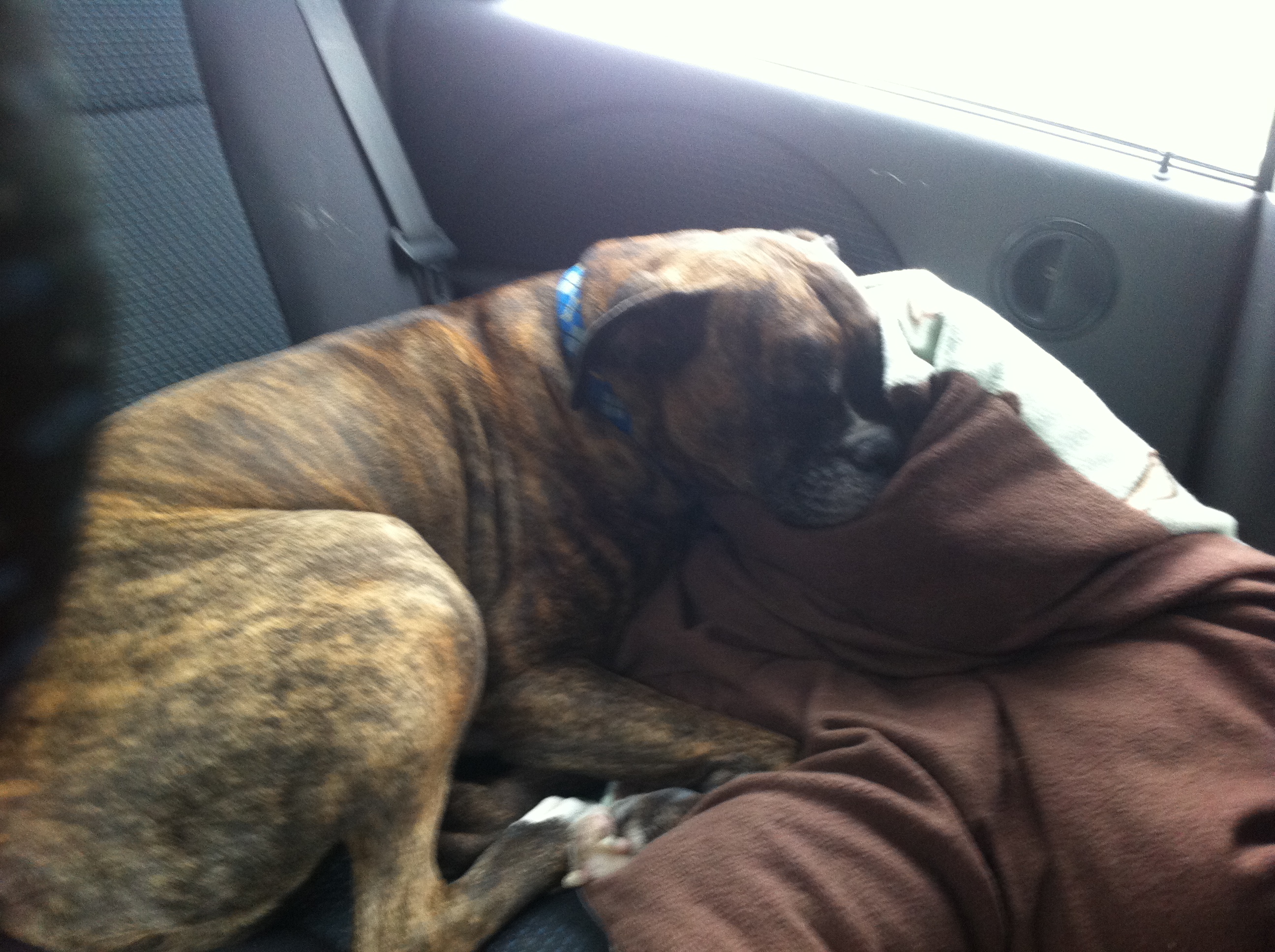
Gunshy says, “Jeez, my Mike drives so slowly, I could run faster than this!”
8. Driving more slowly to and from work
I hate to admit it, but I find myself driving 60 mpr home south on I-23 after school. Yep. I’m the turtle you are passing on the freeway. I’m just trying to save an extra dollar per drive home. My Ford Escape gets best gas milage at 60 MPR, so I leave about 15 minutes earlier to avoid rushing to work or gigs.
Free Press Article: How high do gas prices have to go before you change your lifestyle?
The Dan Plan – Proving the 10,000 Hours Theory
I ran across an article about the Dan Plan today, and I think every musician (or want-to-be musician) should read it.
Dan is your average guy who is doing a slightly phenomenal thing: His plan is to become a pro golfer in six years through hardHe decided he wanted to prove the 10,000 hour theory. (Wait, you’re familiar with Malcom Gladwell‘s theory that one can become amazingly great at something if they put in 10,000 hours of practice, right? Cool.) So that’s what Dan’s doing. He quit his job as a commercial photographer and hits the golf course every day for six hours. He’s doing this for six years, and blogging, posting on Twitter, updating on Facebook during the experience.
Here’s the catch: He’s never really golfed before this self-created challenge.
Can Dan turn from beginner to pro in six years? It’s a long shot, but I’m not following him on Twitter or Facebook to only find out that answer (even though how cool would it be to see him in the PGA!). No, I’m reading for a reminder to be courageous and dedicated. As a musician, I’m finding Dan’s plan completely inspiring, a powerful reminder to stop saying, “Oh, I wish I could have…but I never started when I was younger and it’s too late now.” A powerful reminder to try that inner wish we’ve only imagined.

I think this guy knows what I’m talking about.
What if every person who had an itch to try playing a musical instrument just did it? We’d have new pockets of communities being strengthened. Neighbors would become jam partners. More bars and coffee house would host open mics. More campfires would be filled with music.
Maybe the Dan Plan will help inspire some new plans for future musicians. We don’t have to quit our jobs to do it (well, some of us might have to), but we do need to quit coming up with excuses and recognize hours of practice can be a deeply rewarding experience. Especially when you can finally play that favorite song with your own hands.
Juggling a Cover Song List = Plate Spinning
Lately, I have been ignoring a growing problem: The more cover gigs I book, the more cover songs I learn, the harder it gets to maintain my growing book of songs. In fact, it was starting to feel impossible.
I was forced to acknowledge this problem while playing at Stout in Brighton last weekend. Paul, a returning patron who drove all the way from Ypsilanti to catch my gig, struck-up a conversation with me during my break. “Mike, that’s quite a book of covers! How do you keep them all fresh in your head?” he asked.

This is what my brain is becoming!
“Well, honestly, I don’t!” I replied. “I trust quite a bit of muscle memory.” He laughed and said he had some homework to assign me, requesting I add some Life House tunes to my set.
This struck me. I used to know “Hanging by a Moment,” two summers ago, but had long forgotten it. In fact, most of my rehearsing for cover gigs had been so one-sided, only focused on only learning new songs, that I was making simple mistakes in songs I should know like the back-of-my-hand. “Drift Away,” “Ohio,” “Mary Jane’s Last Dance,” “50 Ways to Leave Your Lover”–I was forgetting a lyric here and a chord there in tunes I rely on too much.
I needed to face it: I was having trouble keeping 200+ songs fresh while finding the time to learn new songs.
Last week, I decided to find an answer to a difficult question: How can I balance my rehearsal time between “old songs” (songs I already play) and “new songs” (songs I’ve just learned) and still put on an energetic performance? I needed to view my cover song list like a plate-spinning juggler does his plates. So I found my plates, by dividing my master cover list into four sections.

Picture doing this juggling act with songs!
This week I’ll be blogging about each section in more detail and how I’m targeting my juggling act to reach these goals:
1. Continuing to add new songs to my cover list
2. Fixing the problem of neglecting my regular cover songs
3. Feeling better prepared each week