I’m pretty excited to be able to use Spotify. Nat would say this is an understatement. I haven’t stopped talking about Spotify since I signed up last Saturday. More importantly, I haven’t stopped interacting with music since then either.
Today, Nat said, “Hey, there’s a new Death Cab album?”
“Oh, yeah. I’ve been meaning to check that out,” I replied.
“Hey, so go check it out!”
Boom. Instant. Playing in the family room. Streaming from my phone to a wireless speaker set-up.
I was showing Spotify to my dad on Sunday and he was impressed. “Look up Elmore James!” Not only did Dust My Broom, a CD collection my dad and I claim as a favorite, it had at least 50 more albums featuring Elmore James, people doing Elmore James, compliation featuring Elmore James and other slide guitar players I didn’t know, etc.. My dad and I consider ourselves pretty intense blues fans, but even we don’t have 50 compilations including Elmore James.
This is indeed what Chris Anderson is describing in The Long Tail, how digital possiblities make shelf-life zero, so niches can go deeper into their specialities.
I feel a rekindled excitement about engaging with music again, like when I was 13 and discovered my dad’s vinyl collection hidden in a cabinet. The difference is this cabinet is endless. Plus, I’m virtually encouraged to try everything without fear, without guilt, with pride! I’m sharing songs with my friend Alan (who sent me Counting Crow’s “Einstein on the Beach,” a song I haven’t heard since high school!) Jake is sending me cover song requests which I can listen to instantly. I’m starting to read up on music blogs like ConsequenceofSound to find new acts to try.
This is just the coolest thing that’s ever happened to music since the birth of the electric guitar.

Week One of My Mission: Learn 100 Cover Songs this Summer
In June, I made a goal to learn a 100 cover songs this summer. I wasn’t focusing enough on my mission, so I dedicated 10 hours of rehearsal time this week to learning covers. Here’s what I finished so far. I performed six tunes (highlighted in red) for the first time at my Brighton gigs this weekend.
- For the First Time (the Script)
- Ooh La La (Faces/Rod Stewart)
- I Want You to Want Me (Cheap Trick)
- Hotel California (The Eagles)
- Tainted Love (Soft Cell)
- Send Me on My Way (Rusted Root)
- 867-5309 (Tommy Tutone)
- Sweet Pea (Amos Lee)
- Two (Ryan Adams)
- Homeward Bound (Simon & Garfunkle)
- Mrs. Robinson (Simon & Garfunkle)
- Ventura Highway (America)
- Give a Little Bit (Supertramp)
- Roll to Me (Del Amitri)
- Don’t Ask Me (Billy Joel)
- Angel for Montgomery (Bonnie Raitt/John Prime)
- Folson Prison Blues (Johnny Cash)
- Drops of Jupiter (Train)
- Breakeven (The Script)
- Hey There Delila (Plain White T’s)
- She’s So High (Tal Bachman)
- Chariot (Gavin Degraw)
- Danny’s Song (Kenny Loggins)
- Losing My Religion (REM)
- Maggie May (Rod Stewart)
- Amie (Pure Prairie League)
- Against the Wind (Bob Seger)
- Night Moves (Bob Seger)
- You’ll Accompany Me (Bob Seger)
- Summer of 69 (Brian Adams)
- Don’t Stop Believing (Journey)
- You’ve Got a Friend (James Taylor)
- Half of My Heart (John Mayer)
- Squeeze Box (the Who)
I’ve made solid progress on the other fifteen, but not well enough to perform them competently. I hope to add those songs for next weekend in Tawas.
Fingerpicking “Danny’s Song”
I also made some improvements learning fingerpicking patterns while transposing “Danny’s Song” by Kenny Loggins and Jim Messina. I used to play this song with Aaron Noone in 2006, but I would only add guitar fills while Aaron did the bulk of the chord work and singing. (I sang harmony.) Really, Aaron did all the work and I was along for the ride.
It was time to learn the song more competently, but there aren’t many helpful tabs or YouTube tutorials that address the fingerpicking pattern. This might have been a blessing, because it forced me to decipher it myself after an hour of work! The beginning verse is using a T-M-I-R pattern over D C Bm | E(7) A(sus4) progression.
If you aren’t familiar with fingerpicking patterns, I recommend picking up The Guitar Grimoire by Adam Kadmon. It offers an introduction into fingerpicking exercises, pattern and notations! I might do a little YouTube tutorial of the fingerpicking pattern of “Danny’s Song” this week.
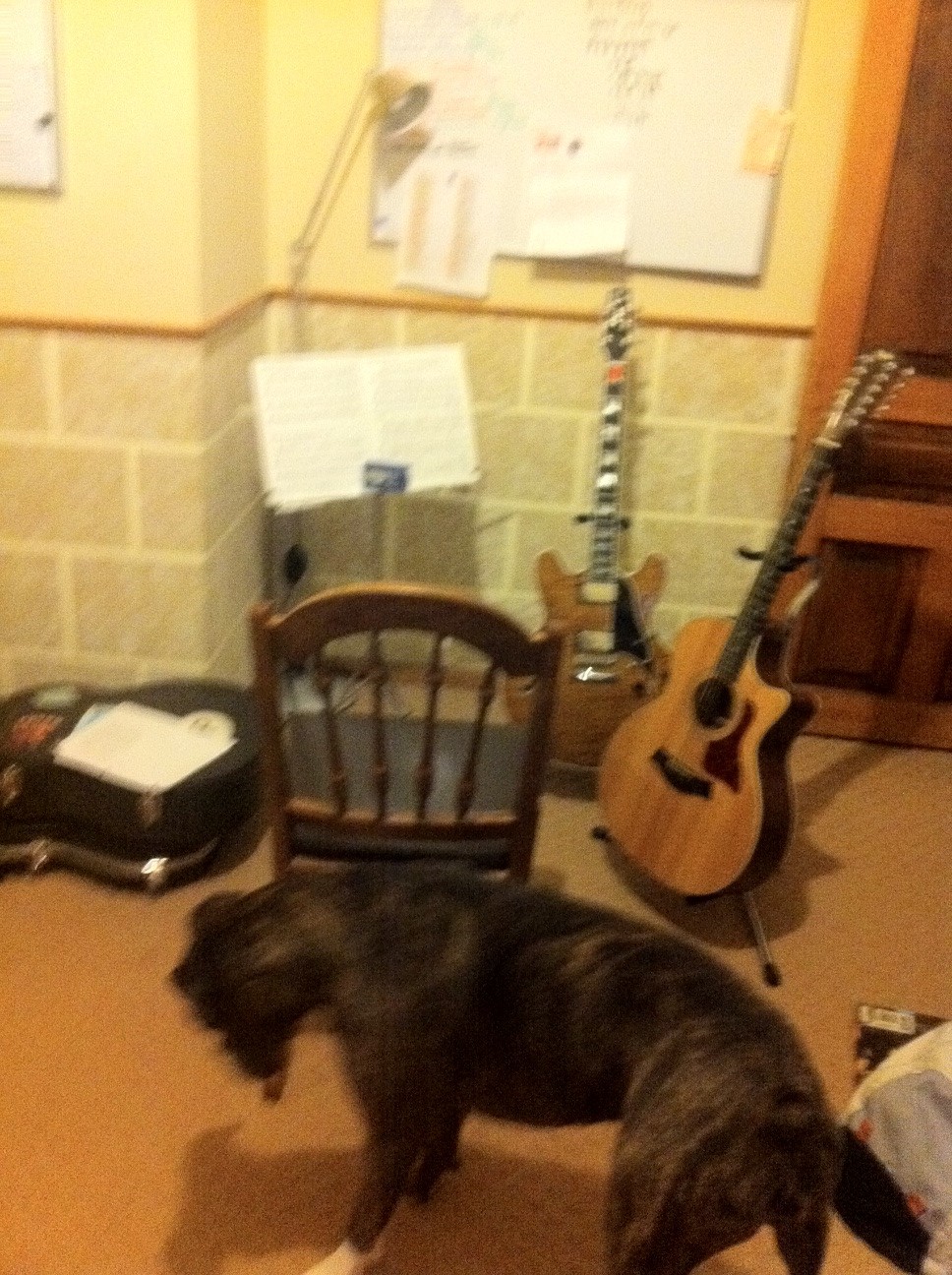
While many are getting summer tans, Gunshy and I are hiding out, working on songs.
Any anti-Harry Potter comments today only illuminate how the speaker has never read pages 720-721 of The Deathly Hallows. Unbelievable power in these musing about life and death. The movie, while enjoyable, doesn’t even come close to doing the final chapters justice. I can’t stop read reading these pages over morning coffee.
My mom is really good at finding lost stuff in the house. She’s got St. Anthony on speed dial.
Now, she might be an expert because she misplaces her sunglasses and keys multiple times a day. (Ha, ha! sorry Mom!) However, I don’t think that’s the only reason. We all lose stuff, but how come my mom can always find often do we find it when we really need it?
No, my mom is really good at finding lost items because she’s just so damn persistent. She won’t give up! She looks everywhere. Tears up the drawers. Looks through ten purses. Checks every table in every room.
I’ve heard the stereotype, “Men never find lost things because they only look in the places it should be.” I laugh at this, but it doesn’t tell the whole story. We must also add, “–and then give up.” If it’s not where it’s supposed to be, I give up.
Not just men, but musicians and songwriters too. Musicians often lose dreams. Songwriters often lose inspiration to write new songs. Sure, finding your lost dreams and inspiration might seem different than finding your lost keys, but I don’t think so. It takes the same thing: Persistent. You need to look everywhere for them. Tear up the house. Tear up your life. Tear up your heart.
Yep, right next to those lost keys are those dreams and future songs. You’ll find them. They are simply somewhere else than where they should be.
To Be a Great Musician, Quit Every Instrument
I’m reading Seth Godin’s The Dip, a book about quitting, and I think one of the secrets of a great musician is that they quit playing so many instruments.
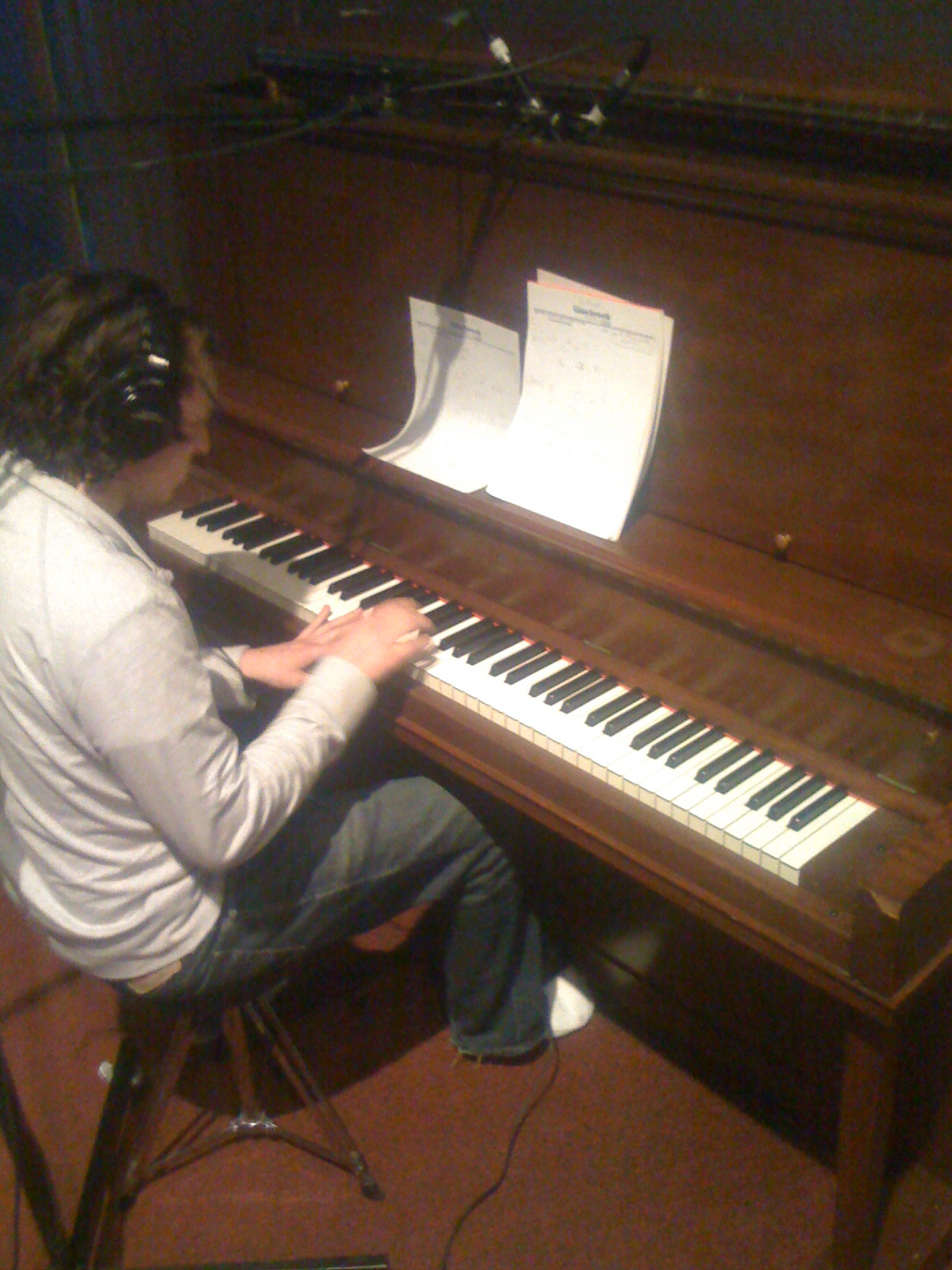
When’s the last time you talked to a guitar player and asked them how they got started playing? “Piano lessons.” Countless guitar players were dragged to piano lessons as children and forced to read shape notes and little classically based exercises until they finally said, “No mas!”
I’m one of them. From third grade to sixth grade I was attending piano lessons with Mrs. Guthrie. She was 88-years-old, one year for every key of her baby grand in her basement, and the best piano player I’ve ever met. She was a patient teacher, too. However after year two and a half, my mom realized I wasn’t practicing enough. She asked me, “Mike, would you like to take a break from piano lessons?”
Low and behold, this allowed me to find something new: By middle school I had moved to guitar and there was no going back. The best thing that happened was being allowed to “take a break.” To quit.
Here’s the secret though: Those three years of piano lessons made learning the music theory of guitar less foreign, more approachable. Plus, now when I talk to keyboard players about mixing our parts together, I understand a little of what they are doing. We are speaking the same language.
I’ve tinkered with harmonica, trumpet, mandolin, bass, piano, organ and some percussion. I suck at them all. They sit around my music studio like little neglected children impatiently waiting to wail.
Honestly, I’d love to be great at all of these instruments, but if it takes 10,000 hours to get great, I’m not sure I can practice them all enough to ever get there. I hope to become competitent at a few in time, but I know what I am. I’m a guitar-player first.
My real purpose of tinkering on many instruments is so I can understand these instruments better, so I can hear them better on records, so I can talk to professionals that I hire more clearly. Plus, it’s fun.
So don’t hesitate to gather those musical instruments around the house; don’t hestitate to drive your fiance or girlfriend crazy by walking around with a harmonica in your mouth for 20 minutes a week; but don’t forget to know your principle instruments and really hone in on one, two, or three instruments very well, depending on how ambitious you are. We don’t all need to be multi-instrumental gods, but it’s sure good to be able to speak to those gods when they are playing to our songs.