Here’s my criticism of Headliner.fm: It’s disingenuous, where talking about music becomes an ad campaign. And no one likes being advertised too. This is written especially for independent musicians.
 If you aren’t familiar with Headliner.fm, it’s a platform where bands make campaigns to get others bands to share posts about them on Facebook, Twitter, [and Myspace; yes, really, Myspace]. Each band gets “band bucks” for their total number of followers on Twitter and fans on Facebook (and Myspace). They then use these “bucks” to get promotion space from other bands’ social networking posts.
They call it “artists helping artists…” But let’s call it what it is: Transforming an artist’s updates into advertising for others artists in hope of others doing the same.
An indie artist should avoid this. Your friends and circles will not appreciate their Twitter and Facebook feeds being filled with campaign posts done for disingenous reasons. Turning your status posts into advertising platforms taints music, clutters social networking. Kim Kardashian might accept money for her Twitter feed to mention you, but no one respects her for it. I also doubt that type of advertising creates lasting business either. Impressions for the sake of impressions is a waste.
But wait, you say. What about the testimonials? OK, the site brags how Rob Thomas used it, saying, “Headliner did an amazing job in promoting the Rob Thomas Artwork Contest on all of Rob’s social networks.” Indie artist beware: This has little relevance to you. If others promoted a major label act like Rob Thomas who has 10 years of name recognition, his name did the selling.
An indie artist attempting to do the same will have much less to gain, but I argue more to lose. In time, people will catch on to being advertised to through Facebook and Twitter posts. They aren’t going to like it, and they will leave your site.
I’m not saying you shouldn’t talk about other bands’ music. You should! That’s the point! Share what you love! Don’t do it because you want to earn ‘band bucks,’ because you want Rob Thomas to post about you on Twitter. Ryan Adams talks about metals bands all the time on Facebook. I love this because I assume he does it because of his passionate love of metal music! I’m a closet metal head too! But if I discovered those bands were paying him to talk about them, I’d feel cheated.
Music business is a business, but the act of making music is a social endeavor. It’s an art. It’s not selling tupperware in a pyramid scheme.
Ignore Headline.fm and invest your time in real relationships. Start small and regional. Get off your fricking computer*. Go meet people. Attend shows. Join an open mic. Share music that you like. Release some free music, sell other releases. Make more music that a niche of people will like. And be patient.
*PS: I’m guilty of spending too much time in front my laptop too. I spent time writing this blog when it’s 64 degrees outside in November in Michigan.

You can download the new EP Where the Sand Meets the Tide for free at mikevial.com/free! I had over 100 downloads in the first few hours of my Facebook announcement Tuesday, and I’m excited to get this music out there! There will be a few reviews popping up this month in the Michigan press outlets.
Also, Natalie’s blog (OK, OK, I’m participating too) about our plans to have an all Michigan-made wedding (My Mitten in Yours) is starting to get some press, too. She received a call from the Lansing State Journal and they had us do a little photo shoot at the Capital Market holding up Michigan-made products and toasting Uncle John’s Michigan wine last week. An article about the blog will be in the Sunday paper.
Lots of good stuff happening in November!
It has come to my attention that mustaches and beards have exploded as the trend. As my friend Brian Walker exclaimed on Facebook, “The beard fashion is out of control!”
I was playing at a bar in Kalamazoo and every male had a beard. I was the only clean shaven guy in the place.
This reminds me, my college friends are trying to continue an annual event called the Mustachular, an event created before the epidemic of facial hair fashion took off.
Of course, the mustachular–a month long mustache cultivation that ended at a local pub to display–would be planned the month I had Parent Teacher Conferences while I was teaching at HHS, so of course I would have to look like an odd idiot during conferences if I wanted to participate. (Which I did.)
Let’s revisit:

I think it’s time to host another mustachular. If anything, this creates a reason to get my friends together, which we don’t do enough.
A Simple Secret to Learning Music: Study in Sections
It’s been two months since I bought a keyboard, and I am remaining dedicated to my goal of teaching myself piano. This includes forcing myself to read music out of an old Music for Piano book that I used in third and fourth grade (before quitting to take a hiatus from music to focus on Nintendo.)
 Today, I learned “America the Beautiful,” the easy kids version. When I was in third grade, my piano teacher gave me a “Bravo” for my ability to play this. Today, she would be proud of me again!
Forcing myself to be a beginner at a musical instrument has helped me improve my teaching of guitar to beginners, too. As students, it’s easy to fall into practice habits that don’t help us improve. For example, we might only practice a song from start to finish, staying frustrated, wondering why we never improve.
Today, I had to apply the simple strategy of studying a piece of music in isolation, breaking it up into sections. While “America” is an easy song, there are a few tricky parts. You’ll notice form my pencil marks that I split the song up into three sections. I first practiced the song left and right hand individually. Then I practice each section with both hands, using a metronome set slowly at 48 BPM.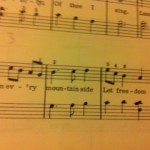
Part three really was the trouble spot. I realized I could play the middle section easily, but really needed to practice the end of the song. So that’s where I spent my focus.
Isolating Guitar Parts for “PYT”
Last weekend, I learned Michael Jackson’s “PYT” from Thriller, and this same concept of practicing sections in isolation applied to my study of the guitar parts. This song has some amazing rhythmic parts, and I never could have learned this without studying each section individually. Levi Clay has created a helpful Youtube video, complimented by some detailed music charts at his website. Notice how Levi breaks up the song into sections. That’s how I studied them.
As a high school teacher, I used to say, “Repetition is the key to knowledge!” all the time in my classroom. I even had a poster on the wall deeming this phrase. Honestly, I believe the secret to why some musicians get really proficient and why others give up is simply found in how they practiced: focusing on the hard parts and studying in isolation, over and over again.
3 Tips to Keeping Your Acoustic Humidified
It’s that time of year again, the time where I not only dread taking my dog for a walk in the cold weather, but also dread the challenge of protecting my Taylor acoustics from low humidity in the air.
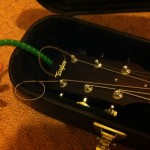
Dampits Humidifiers
Last winter was awful for my guitars, and I paid for it this summer when I needed to get four guitars set-up before recording in the studio. After fixing my guitars intonations and frets, Mark Weninger, my guitar tech, reminded me to not only humidify the room, but also humidify my guitar cases.
Here are three tips Mark shared with me:
Tip 1: Use two humidifying systems in each case
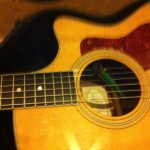
Don't use the plastic cover over the sound hole!
I’m using two Dampits in each case, one in the guitar and one at the upper part of the case by the headstock. (I may even need to use three if the season is extra dry.) The goal is to keep the humidity of each case’s environment at 50-55%. Mark said, “Don’t use the plastic, sound hole cover that comes with the Damp-It. Your goal is to keep the case humidified too!” Mark also stresses the need to be very careful in clearing the excess water of your Dampits to avoid water spots developing in the guitar.
Tips 2: Use a humdify reader for each case, not 0nly the room.
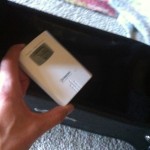
Having a humidity reading of the case is as important as a reading of the room.
I’m keeping an Oregon humidity sensor in each of my Taylor cases. These small sensors wirelessly send the humidity reading to a larger humidity reader that sits on my shelf. This allows me to check each case’s humidity without having to open the case.
If it seems expensive to buy this many readers, note a fret replacement on one acoustic will cost you $250.
Tip 3: Open sparingly! Leave the acoustics in their cases as much as possible!
I hate opening a case each time I want to play too, but the winter isn’t the time to leave your acoustics on stands. Each time you open your case, you compromise the controlled environment.
Now, I’m still doing my best to get my music studio room to 39-40%. I have two, smaller room humidifiers in my room.
* * * Bonus Tips: A few thoughts about gigging and humidity * * *
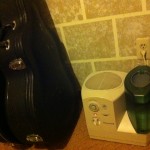
It's impossible to keep a room at 55% in Michigan, but I can at least get it up to 38%
If you gig a lot, be cautious when transporting your guitars too. Avoid leaving your guitars in the trunk, so they also can stay at a comfortable temperature with you. Also, if you can avoid it, don’t leave your guitars in the car when you arrive at the gig. Bring them inside the bars and clubs when you arrive, and let them adjust to temperature changes before opening the cases.
Once you get home from your gig, stay focused about getting your guitar case back to 55% humidity level. Resoak those Dampits. Avoid opening the case for a while. If you are doing your best to keep your cases at a controlled environment before and after a gig, your acoustics should be able to handle the weather even better than you.