I’m having a grunge day (as Nat called it) learning Nirvana songs. It’s always fun for me to revisit 90s era tunes that I couldn’t play on guitar when I was taking guitar lessons in high school. Nirvana had a special place during my learning of the guitar and how to read tabs. I slaved over “Lake of Fire” for months!
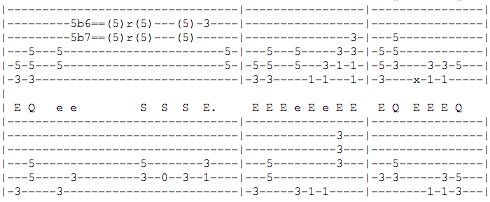
One thing that confused me was seeing a tab of guitar parts like a G5 chord broken up into chunks:
Today didn’t start with learning Nirvana songs. I was browsing Netflix over breakfast and got hooked into some Nirvana documentaries available on stream-it-now. Anyone watch the documentary on Netflix with producer Butch Vig at the mixing board sharing some of the recording process and tracks from the Nevermind sessions? So cool. It touches the soul to watch Vic just listen back to the tracks he recorded with Kurt, Kris and Dave, and say, “This is beautiful…”
Anyways, my teenage-self is ready to wear flannel again. Unfortunately, I’m three years older than Kurt Cobain lived, so I’m too old for that publicly display of adolescent tendencies; I’ll just wear some long-johns under my clothes and no one will be the wiser.
http://movies.netflix.com/Movie/Nirvana_Nevermind/70026992?trkid=2361637

From the opening wedding scene of Upton Sinclair’s The Jungle, a description of the musicians:
“The musicians–how shall one begin to describe them? All this time they have been there, playing a mad frenzy–all of this scene must be read, or said, or sung, to music. It is the music which changes the place from the rear room of a saloon in back of the yards to a fairy place, a wonderland, a little corner of the high mansions of the sky.
The little person who leads this trio is an inspired man. His fiddle is out of tune, and there is no rosin on his bow, but still he is an inspired man–the hands of the muses have been laid upon him. He plays like one possessed by a demon, by a whole horde of demons. You can feel them in the air round about him, capering frenetically; with their invisible feet they set the pace, and the hair of the leader of the orchestra rises on end, and his eyeballs start from their sockets, as he toils to keep up with them.”
(Sinclair 10)
God, isn’t that gorgeous, yet frightening prose? And if you just happen to hold an instrument from time-to-time, inspiring?
Don’t forget musicians, you are the reason a simple room becomes a wonderland. Play like a demon has grabbed you.

Yesterday, I posted a blog about the need to refrain from sharing every song we write on the Internet, and urging for an allowance of time, editing, and exclusion to let the best songs shine.
If sharing a new song immediately with friends, family and Facebook isn’t the best idea, where should we share these new compositions to test them out?
Here’s some thoughts on where to share.
1. Open mic night!
Isn’t this why open mics are here? A laid-back, public place, often full of other songwriters, with a slot to share music without worry of audience’s reaction. John Mayer does little surprise performances in NY, usually playing new songs. We should do this too!
Get to openmike.org and find circles with a healthy community of attendees! Not all open mics are successful, but there are gems in every city, like Jen Sygit’s at Dagwood’s in Lansing and Brian Pobocik’s long-standing Flint open-mic series.
2. Songwriting circles or workshop
This is similar to open-mic night, but with a heighten level of attentive ears, people who are more willing to listen to others and share thoughts than simply be waiting for their turn to play at the open mic night.
I’ve heard of many friends of mine attending John D Lamb’s songwriting retreats in Northern Michigan. Songwriter’s Anonymous often host monthly nights at the Trinity House in Livonia, MI. Find similar havens in your hometowns!
3. With a trusted small, songwriting community of local musicians
These need to be the right people, though. Ones who have attentive, educated ears, but also have a kind way of sharing criticism. I really only have two people I trust to share new music: My fiance Natalie and my old bandmate and good friend Alan Black. (For ten years, all I had was Alan!)
You need to find people who inspire and challenge, not bash and criticize. The best way to find this community is to first be one of those listeners yourself. One could have a private Soundcloud account to share with a small group of people.
4. Online Forums Focused on Songwriting and Sharing
This is an option I’ve yet to try: Forums with songwriters who are interested in listening to new music.
Don’t confuse this with forums focused on a famous artist, and spamming them with comments of trying to get others to listen to your music. You need to find communities that are specifically created by people interested in listening to new music, and I think the smaller these communities are, the better. 100 people or less. Ones that you might need to be welcomed to join, or start one yourself!
The Yellow Room Gang is a group from Michigan who started as a simple a circle of songwriters/friends getting together to just share new music. I think more of these organic circles are needed for musicians to stay inspired and get feedback.
Congrats to MSU student Christina Strong for finishing her documentary on the expense of getting a college education!
We donated our song “One Way Road” to be used in her student film titled Expense of Learning.

Taxi had a great Monday podcast with Ralph Murphy (of ASCAP) about songwriting goals and what makes a song a hit for radio or TV/film placements. One quote from Murphy really struck a chord with me: How many songs does a professional songwriter write a year? Murphy answered, “They write about 100 songs a year, demo 30-40 of them, and get a hit every third year.”
Ralph Murphy said, "A professional songwriter writes 100 songs a year, demos 30 to 40, and gets a hit every third year..."
Whoa! 100 songs!
First, let’s define what type of professional songwriter Murphy is describing: These are the men and women in Nashville who write for a living, pitching songs to artists to record and perform. I’m assuming many of these songwriters don’t tour or perform as much as say, Jason Mraz, or even me. They spend most of their musical professional time writing and demoing.
So a songwriter who wants to be a performing artist shouldn’t feel overwhelmed with those numbers, meaning you don’t need to feel like you need to write a 100 songs a year to be considered a pro songwriter; however, this point is still relevant: you do need to write A LOT to find the great songs. It’s a constant journey.
Want to Spread Your Music? Then Stop Sharing It.
Right now the tools to share music are wonderful. Soundcloud. Bandcamp. CDBaby. Whatever we use to share music, it’s all at our finger tips. However, I see quite a few acts, ones that are pretty young, trying to release every song they write, often releasing demos the day, week, or month after they write them.
This is a bad idea.
Why? Well, how would you feel if a company who makes cookies released every product before demoing or taste tasting them? Mediocre products that aren’t worth your time ending up on your kitchen table–this makes us annoyed that we wasted our money.
I know music isn’t food, but it’s got to be satisfiying for the audience. The professional songwriters already exclude 60-70% of the material they write before they get to the demoing process! Then, how many of those 30 or 40 will actually get pitched to Toby Keith’s management?
Music, even if free, is spending a person’s time to listen to it. We all wish we had more time; we seem to have less as we get older. So when you request your (often small) audience to listen to works that are lacking, or aren’t fully developed, you are wasting their time.
Plus, they are learning to expect your music to be mediocre, and they will stop paying attention all together.
This doesn’t change for even the established writers. Author Joyce Carol Oates said in her book The Faith of the Writer that after she writes a first draft of her book, she puts in in desk for a year before coming back to it!
OK, we shouldn’t wait a year to release music, but the Internet is making new songwriters and artists compulsive. We feel compelled to share every new idea with followers, and we feel good to get that “like” on Facebook or a few hits on a Soundcloud recording.
But are we asking the right questions when the buzz dies quickly?
Why didn’t this song take off?
Why did Christina Perri’s new single get 140,000 hits on Youtube since March 22 and mine only get 100?
The new songwriter often answers, “I just need to get more people to listen!” This is true, but only a part of the story. It’s most likely that song or performance wasn’t ready for an audience’s ears yet either.