How did you get your start? (& that one time I saw John Mayer get his start playing at a bookstore)
“How did they get their start?”
I obsessed over that question.
I think this question started taking over my brain because of my experiences watching John Mayer’s career grow before my eyes in 2000-2001.
I discovered Mayer’s music from a sampler CD that lead to finding his self-made MP3.com. (Remember when that existed?) I went to see him play his first gig in Michigan at the Shelter in Detroit,with Howie Day. I even saw him play at Borders Bookstore in Ann Arbor!
Within two years, I had watched his career jump from 300 capacity clubs to the Michigan Theater to DTE Music Theater.
It was nuts. Probably inspired me too much. I kept wondering, how did he get his start? What’s the path I should follow?
Here’s the secret. You start by just starting. There is no one path. Every musician and artist started their journey by simply putting one foot in front of the other.
You find time to work on your craft, every month, every week, every day, every morning. Whatever you can. You stop asking, “How did they get their start?” and start. The rest will follow.

Remember that time you were in a class where the teacher lectured for the entire period?* It doesn’t take long for our minds to wander.
The speaker doesn’t often know he or she’s lost the audience. Why? Well, most people are courtesy. They pretend to listen. (Or at least they used to pretend to listen before cell phones had Internet access and text messaging.)
The same problem can happen for a performing musician, especially the acoustic-styled singer-songwriter, the folk troubadour.
“Don’t speak song introductions longer than the actual song!” is one common joke.
It took me a while to realize I had to plan out, even practice, my song introductions and stage banter ,just like practicing the songs.
You don’t need to write out a speech, but you sure need to visualize what you are going to say.
One might say, “That takes away the magic,” but I argue that any good improviser practice improvisation. Practicing is what allows us to find the magically moments.
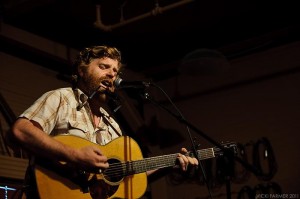
Peyton Tochterman is one of those songwriters who can get away with breaking the rule, and share a mighty fine, long story! Ask him to share his adventure playing in Afghanistan!
* I know Holly grads, I know. I was guilty of this a few times.
In my last post, I mentioned that I don’t believe we will hate our hobbies if we make them our jobs. (Read here.)
That being said, I also don’t believe everyone needs to feel compelled to make their hobbies or artistic passions their jobs.
- I enjoy writing poetry. I have no interest in trying to make a living from it.
- I enjoy running a few miles a week. I have no interest in becoming a sponsored runner. No interest in running a marathon.
- I enjoy posting photos of my dog to Instagram. I have no interest becoming a photographer.
But I can’t live without playing, listening, analyzing music. I seriously can’t function.
In Catholic school, one my religion teachers incessantly talked about being open to “a calling.” (She didn’t mean a calling to become traveling troubadour, but too bad. That’s what happened.) Since I was 16, I would play for eight hours straight during the weekends in my parents’ basement. My mom and dad would take the earplugs out of their ears and joke, “That guitar must be a part of your body now.”
That wasn’t far off.
Making a living from music is more about my ability to enjoy music as much as possible. I feel blessed to be able to do this, but it’s also a curse. If you asked me what I would also enjoy doing if I couldn’t play music, I wouldn’t be able to come up with an answer.

How I make time for lunch.
You Will Hate Your Hobby If You Make It Your Job
“You might hate music or art if you try to make it your job.”
That was the worst advice I’ve ever received during my senior year of high school.
I often parroted this ridiculous explanation to people who asked me why I was teaching rather than playing music. “Oh, I think I’d grow to hate music if I did it full-time.”
(Wrong. I wasn’t pursuing music then because I was scared I wasn’t good enough or that I wouldn’t make enough money.)
You see, no one hates their art or music when they make it their job. You might hate the business around the art or music, you might dislike traveling long hours to gigs, you might hate reading legal contracts, but you don’t hate music.
Same goes for teachers: No one should hate working with kids or dislike their favorite subject (English, math, history) because of the politics or business of the classroom. You might dislike grading papers, you might dislike having too many students in your classroom, you might be discouraged that the govenor signed a bill that decreases funding for education; but you don’t hate working with kids or hate literature.
I stopped believing we hate our hobbies when we make them our jobs. Instead, I believe we love our lives when we can pursue our passions to the fullest; that we are willing to find ways to work around the complications when we care about what we do.
Life is always full of complications. Why not accept the complications around something you love?
Music Major Failure, Major Music Success
In 1999, as a senior in high school, I faced my most disappointing musical failure: I auditioned for U of M and WMU’s music programs (specifically a focus on jazz guitar).
I didn’t get accepted into either school of music. Both rejection letters arrived on the same day, and I decided against auditioning at other schools, like CMU and Wayne State.
After the initial disappointment, my drive to study, perform, write, and enjoy music didn’t change. In fact, facing this disappointment early in my initial interests with music was really important for me. (There were–and are more–to come!)
I’m firm believer in the saying, “One door closes, another one opens.”
During college, I decided to open a different door. I attended WMU and study English/literature to get an education degree. This served two major successes for me:
1. It helped me get over being shy.
2. Studying literature, history and English helped me grow as a person, which helped me grow as a writer.
If I studied only jazz guitar in college, I would have sat in a practice room for hours a day, and graduated with no social skills, no interest in the world outside of a fretboard.* Becoming a teacher gave me the opportunity to do something that was not natural for me, public speaking. It also taught me to think about the needs of others. And reading literature and studying the written word helped me take joy in writing, and in sharing writing with others.
If you are seeking a life as an artist, you are going to hear the word “no” more than “yes.” It’s important to face failure as an opportunity, maybe even a success.
___
*Dear jazz majors and those with music degrees, do note this is an analysis of myself, not other people who have studied music in college.
I was a really shy kid. Guitar helped me open up a bit in high school, but forcing myself to face my fears of public speaking, becoming a teacher, and studying literature passionately with great instructors, in a discussion-based classroom, helped me beat my anxiety.

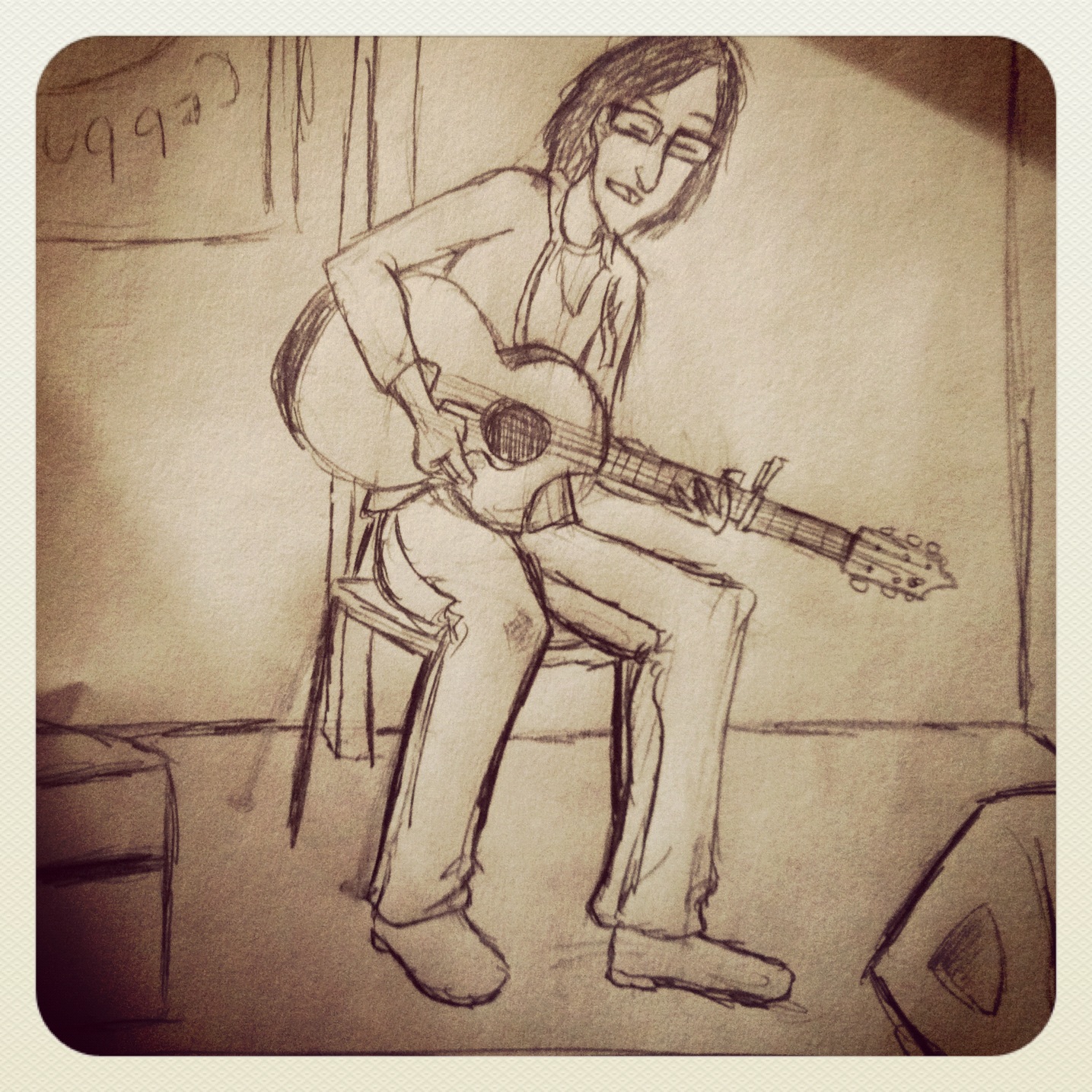
Illustration by Cal Green