When I finish a song, it is inevitably evaluated by two measurements: My personal satisfaction of it, and the reaction it receives from others.
I used to assume my favorite, personal compositions would be my friends’, family’s, and audience’s favorites, too. But that’s rarely the case.
For example, my dad’s favorite song of mine is one of my least favorites to perform, one that is still sitting in demo version on a Catherine North Studios hard drive. Other times, I’ll write a song that I love to perform, and it will get yawns.
If I’ve learned anything, it’s to stop predicting the “home runs.” The best thing to do is to simply enjoy writing for the sake of writing, and let the cards fall as they may.
Yes, we have to write for an audience in mind; and yes, we have to write for our own self expression; but, usually, we have to stop worrying about whether those two measurements will align, especially because worrying can interfere with finishing the song!

You’re almost too old to make it in music…
It was 2007, and I was talking to a booking agent who needed acoustic acts for a local bar. He asked how old I was.
“I’m in my mid 20s,” I said.
“Better do it now. You are almost too old to make it in music,” he replied.
His statement haunted me for the rest of my 20s.
I was one month away from 30 birthday when I left teaching to dedicate 100% of my professional time to music.
I turn 32 years old today, and my birthday remains a marker of how long I’ve been driving around the state, and parts of the country, with an acoustic guitar in the passenger seat.
That agent’s statement doesn’t haunt me anymore. No one gets to tell you that your age will prevent you completely from success, especially when it comes to music.
It’s not that age doesn’t change the decisions we make. When I’m 64, I won’t be carrying around the 72 lb Fender Vibroking amp or the 51 lb Mackie PA I currently use. But that doesn’t mean a 64-year-old can’t make different decisions and play music.
I believe this is a new Renaissance for music, an era where the teen sensations of pop music are outnumbered by the more niches of musical styles floating around Bandcamp; an era where more people are teaching themselves to play an instrument, probably with Youtube videos; an era where more musicians are getting in their cars and sharing their songs to small audiences across the country.
Plus, those who have aged, those with experience of marriage, heartache, and loss, have more to say about love and life than 17-year-old.
Age is just a number. “Making it” is an abstract idea. And music is wonderfully all around us. Let’s blow out some candles together, and keep making that wish.
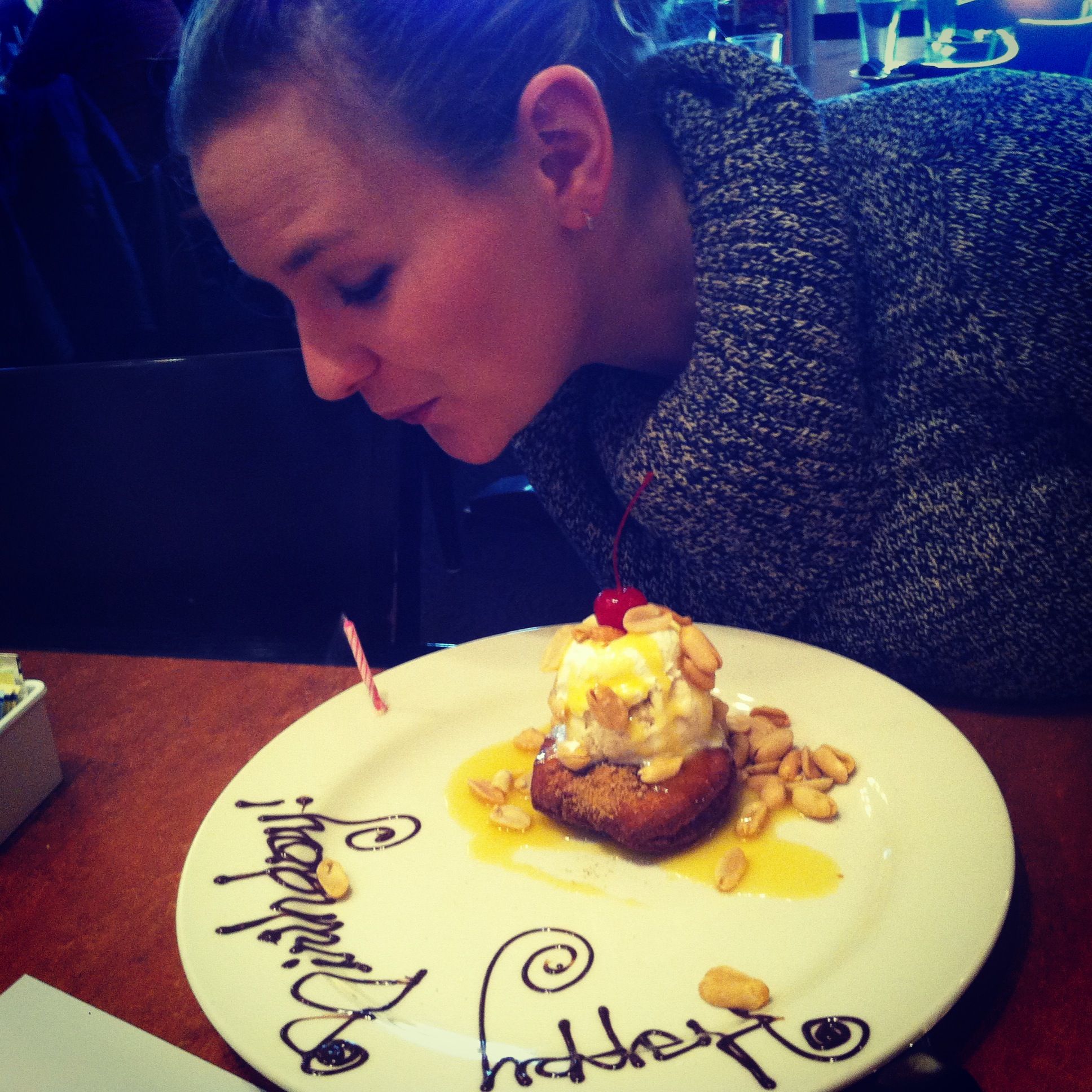
Birthday tip: If you are in Ann Arbor, go to Zingerman's Roadhouse and get a free birthday donut! It's the best, made to order donut you will ever taste.
Did your high school coach say that phrase a lot, too? “Go big or go home!”
That statement was daunting, especially if applied to music. “Go big? I can’t go big!”
However, going big is relative to where we are in our careers, in our creativity, in our interests. Going big doesn’t mean we have to be NBA superstars or selling out the Madison Square Garden.
My friend Tim made a personal challenge to play 52 gigs, hopefully one a week, to encourage himself to take his music more seriously after 30 years of playing guitar. In April 2013, he crossed the finish line!
With music or art, it’s important to go big, but we get to decide what “going big” is.
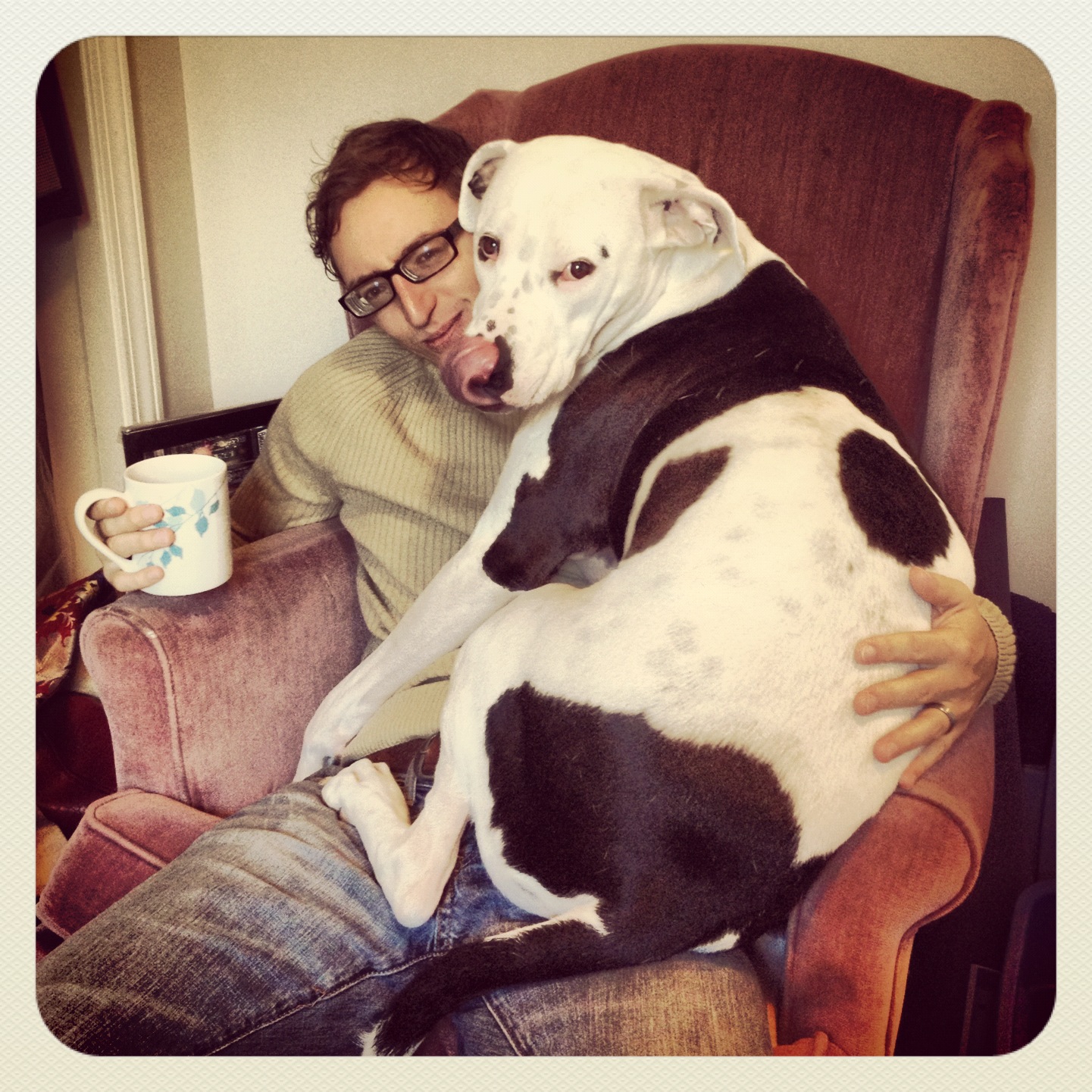
Lois knows what it means to "go big"!
During the hottest day of this summer, I mowed the lawn. It was the worst time to do that chore, but the lawn still got mowed. And it was the only time I had before a stretch of gigs.
Sometimes we don’t have the best circumstances to train for a triathlon, or record a new song, or write that book, or whatever that creative itch is begging us to scratch, but rarely will we fail because it’s not the best day to proceed.
However, always saying, “Now is not the right time…” will end the same way.
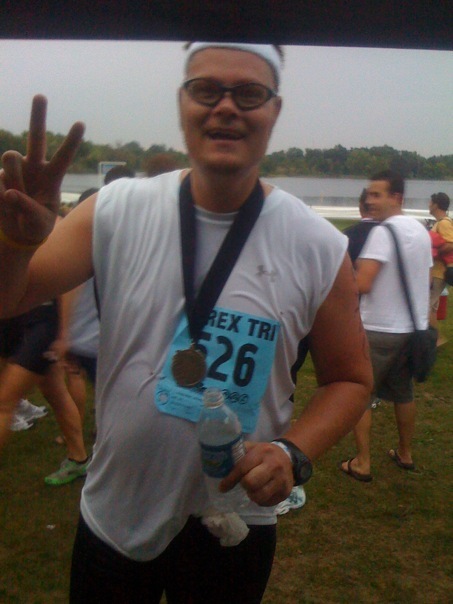
When you train for a triathlon, like my musical friend Justin did, you are bound to have some bad days for training! Even the race day can be a rainy mess, but crossing the finish line still feels wonderful.
The best way to get new people to listen to your music is not about giving it away…
“This music is free! Go download it!”
I see this statement a lot, but offering your music for free doesn’t encourage new people to listen to it. Why? Because so much music is free now!
Here’s another statement quickly becoming a cliche:
“This [formerly on a major label band] is now going indie and needs your help! Support their Kickstarter!” It was an amazing story when Amanda Palmer did it; now it’s commonplace.
* * *
Note, I love Kickstarter and I love how we can offer our music for free. (My wife crowdfunded her first book, and I’ve used Noisetrade to share my music for free. I’m a supporter of these opportunities.)
But this needs to be said: The fact that it’s free or crowdfunded shouldn’t be the story; those are footnotes to the actual story, a story about the music.
* * *
When Radiohead released their music for “pay what you want,” it was interesting, new, exciting. When Allison Weiss had success using Kickstarter, it was a cool story: DIY artist funds new music through crowdsourcing.
But now those stories are commonplace. It’s no longer unique to say, “This music is free!” or “We are using Kickstarter!”
Instead, to motivate people to listen, you need to find the true story. The engaging story. The inspiring story.
Like:
He was working in the mental health industry, fighting off his own depression, privately; and he discovered the best way to fight his own depression was by finding music again. After leaving his job to be a full time musician, his new record, with hints of City & Colour, gives voice to fighting demons.
Or:
She was a back-up singer in a successful touring band, but when her husband found a new job, and she had to leave the big city of Atlanta for Michigan’s Kalamazoo, she thought her music career was done. Little did she know, Kalamazoo would be the place where she would find her own voice, step out into the spotlight, and defeat ‘the wolves” with an Americana sound.
* * *
Stories about the human experience inspire; and that inspiration is what gets new listeners to check out your music.
Whether your music is free or for sale, crowdsourced or self-funded, find your story.