Hi everyone,
I’m releasing my new song, “Reaching Back,” today! Matt Coggins at Arctic Sounds Radio WKUF 94.3 will be debuting “Reaching Back” tomorrow morning on his show starting at 8 AM.
You can download the song for free all month of December either at:
If you download through Noisetrade, that’s a big help! In December 2011, my third EP made the top downloads list at Noisetrade’s homepage, which really helped it get more people seeing it. I’m keeping my fingers cross that I will make the top downloads list again with “Reaching Back.”

Macklemore in South Lyon: What One Could Do
If you don’t like the fact that a teacher was suspended for playing the Macklemore song “Same Love” in the classroom, and you live in South Lyon, then what you could do is inspire change in your school’s curriculum.
Organize a panel of students, parents, and teachers that meet after school to draft up a unit of curriculum (short stories, one-act plays, poems, even songs), one that supports these themes of equality, addresses homosexuality respectfully, and meets the state benchmarks and standards for English or Social Studies (or even drama).
One could even add it to existing curriculum as secondary materials: Maybe To Kill a Mockingbird, Catcher in the Rye, the Outsiders, etc. Present it to the school board. Get it approved. If they vote it down, get them to stand on the record and explain why. Then, redraft and present it again.
An administrator won’t be able to say, “No one is going to have a comment for you. We don’t go on camera here in South Lyon” if it’s about the curriculum. Public school curriculum is open to the public.
One day, a verse of Macklemore’s song could be a text for a writing prompt in an approved curriculum. Right now, it’s a news headline stirring up discussion. That’s the power of art.
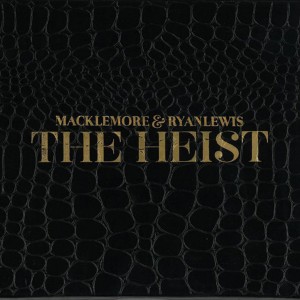
A teacher received a three day suspension (two days without pay) for playing Macklemore’s song “Same Love.” (Article/Fox 2 News here.)
The context of this song is a positive message, but it’s a challenging song by today’s standards. (It shouldn’t be, but alas, it is.)
There are going to be a lot of questions that are circling this discussion. I like this Macklemore/Ryan Lewis song. But before I speak in support of the song, I need to acknowledge one point.
The administration claims the song “had controversial content — homosexuality, religion, politics views and a sexual slur. It also says she should have asked permission to play the song.” This lead me to a question:
- Question: We don’t suspend a teacher for reading a passage with racial slurs if it’s from Huck Finn or To Kill a Mockingbird. Why suspend a teacher for playing a positive messaged song that argues against different slurs?
- Answer: Those books are approved by the school board (who are voted in by the community), and those books are in the approved curriculum. A teacher playing a song, one that is viewed as challenging, one that isn’t approved by the school board or in the curriculum, are at the risk of being reprimanded.
I don’t like this, but there it is.
Suspending the teacher? Insane in my view; but the administration had a legal, contractual right to do it. That doesn’t make it is morally right, but I first need to acknowledge the difference.
So, what can one do about this event if you don’t like it? Well, you could…
As a teacher, I used tell my students, “Don’t get discouraged!” However, I was a hypocrite to offer that advice; I often feel discouraged, too, especially as a musician.
The real challenge is dealing with discouragement. Discouragement is a part of the game, especially when embracing the music business. These feelings can be crippling. However, they don’t have to be. Here are ways I deal with discouragement as a musician:
- Exercise. I can’t tell stress this enough. Having an exercise schedule, at least three days a week, helps clear my head and feel better.
- Have a music goal to practice daily. Music business is unpredictable, but I can always work on my playing. It’s important to feel like you are moving forward. When business plateaus, our instrument is always waiting for us.
- Listen back, and remind yourself you’ve grown. It’s easy to forget how far we’ve come. My friend Stephen Schlaak posted this link about listening back to past recordings, and it’s a great reminder to get a fresh perspective about our playing. I think this idea also applies to our business careers. Review those little victories to encourage yourself to face new challenges.
- Talk to a trustworthy friend or mentor, but avoid publicly complaining. Social media makes it easy for us to whine, but I think the action of complaining increases the feeling of discouragement. While it’s important to get things off our chest, I recommend doing that with a close friend rather than on your Facebook wall or Twitter feed.
- Break it down. We often get discouraged when we don’t meet large goals, but we often need to revise the little steps to get there, which seems more possible.
Remember, it’s OK to get discouraged; it’s just not OK when discouragement interferes.
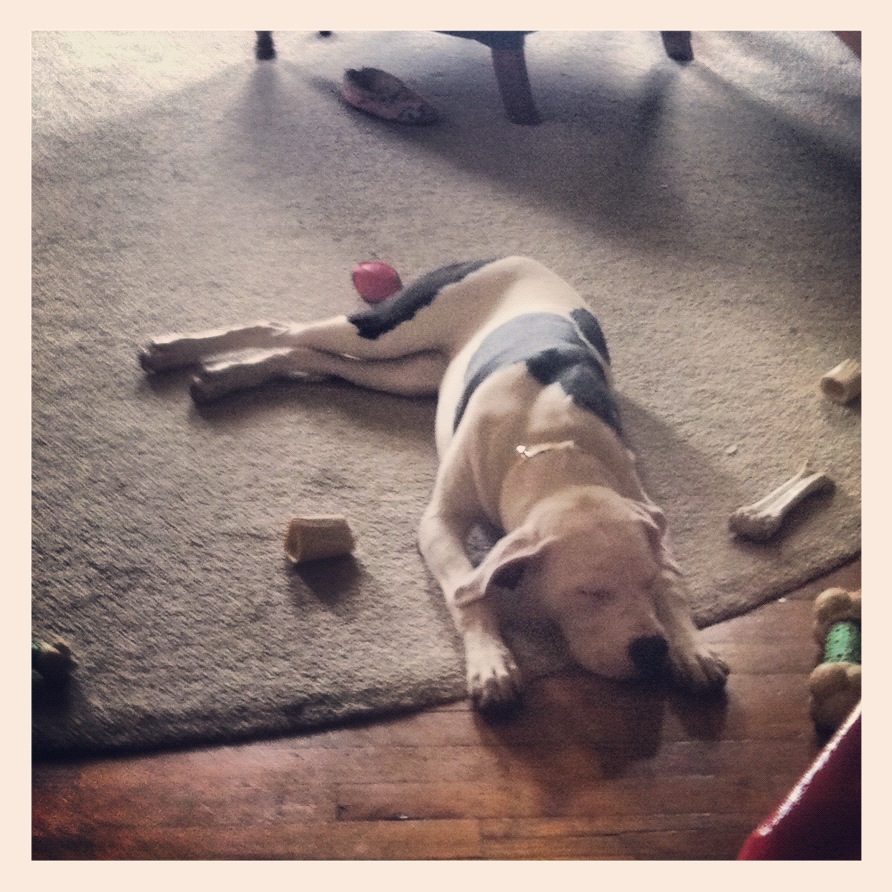
Lois rarely gets discouraged.
Guitar Volume Tips for Small Rooms

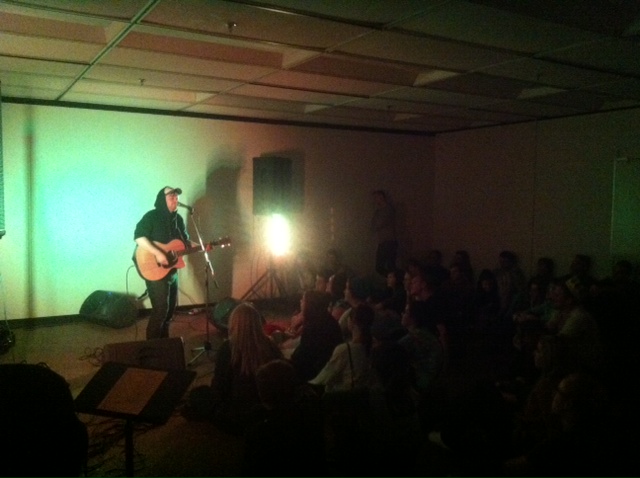
The performance space of Stage D.
On Saturday, I volunteered to run sound for Fusion Shows‘s Livingston Underground benefit festival at the Hartland PAC. The event was a great success, and I enjoyed meeting the bands and running sound for them during the fast-paced day.
Saying it was fast-paced is an understatement: We had 15-minutes between acts to load-in, load-out and soundcheck. Each of the 13 acts played 20 minute sets. Plus, the performance space for Stage D was a former classroom, a space not acoustically designed for live music. Whew! I wouldn’t have survived the day without stage manager Lalita’s help and the bands’ patience and swiftness.
After reflecting about the successful festival, I thought I’d share three tips for young guitar players to consider when performing in non-traditional performance spaces:
1: Use your guitar’s volume knob
- Don’t simply use your amp’s volume knob to control your volume. Your guitar’s volume knob can help you maintain headroom while performing and control volume more accurately. If your amp is a little too loud and the sound guy asks for it to be a hair lower, use your guitar’s volume knob to lower it. Then, you will still have some head-room during the performance.
- You don’t need to have your chords’ volume be as loud as your guitar solos, double stops, or single note leads. Again, uses your guitar’s volume knob to give your single note leads a boast when needed, or get a volume pedal.

Talon performing at LU
2. Practice getting the right volume when engaging guitar pedals
- Over drive pedals and distortion pedals are going to affect your volume. Consider why you are using the pedal: Is it to add tone/distortion to chords during a chorus? Is it to add a new sound on the solo? All of these reasons need to be taken into consideration when balancing your volume. Know your guitar pedals’ sensitivities.
3. Consider borrowing, sharing or bringing a smaller amp for smaller shows
- Professional guitar players have multiple rigs for different groups and different settings. This isn’t a luxury at the pro world, but it’s usually not a possibilty for us when we are starting out. A new guitar player often buys the largest amp they can afford. Sadly,

Avery Black doing an acoustic set at LU.
this amp is usually too loud for the rooms they will start performing! The fact is a 4×12 cab isn’t going to be necessary for a room that’s 30 x 32. Even a 2×12 inch 100 watt amp is going to be too loud when seeking the sweet spot of the tube amp’s tone. I admit when using a tube amp, I want to get the gain cranked to get the sweet spot of the tone. What if the that sweet spot is found at way too loud of a volume for the room? Be open minded to having a smaller amp for smaller shows.